


The chart below shows how much diesel select listed companies burn through every year, based on their annual reports.
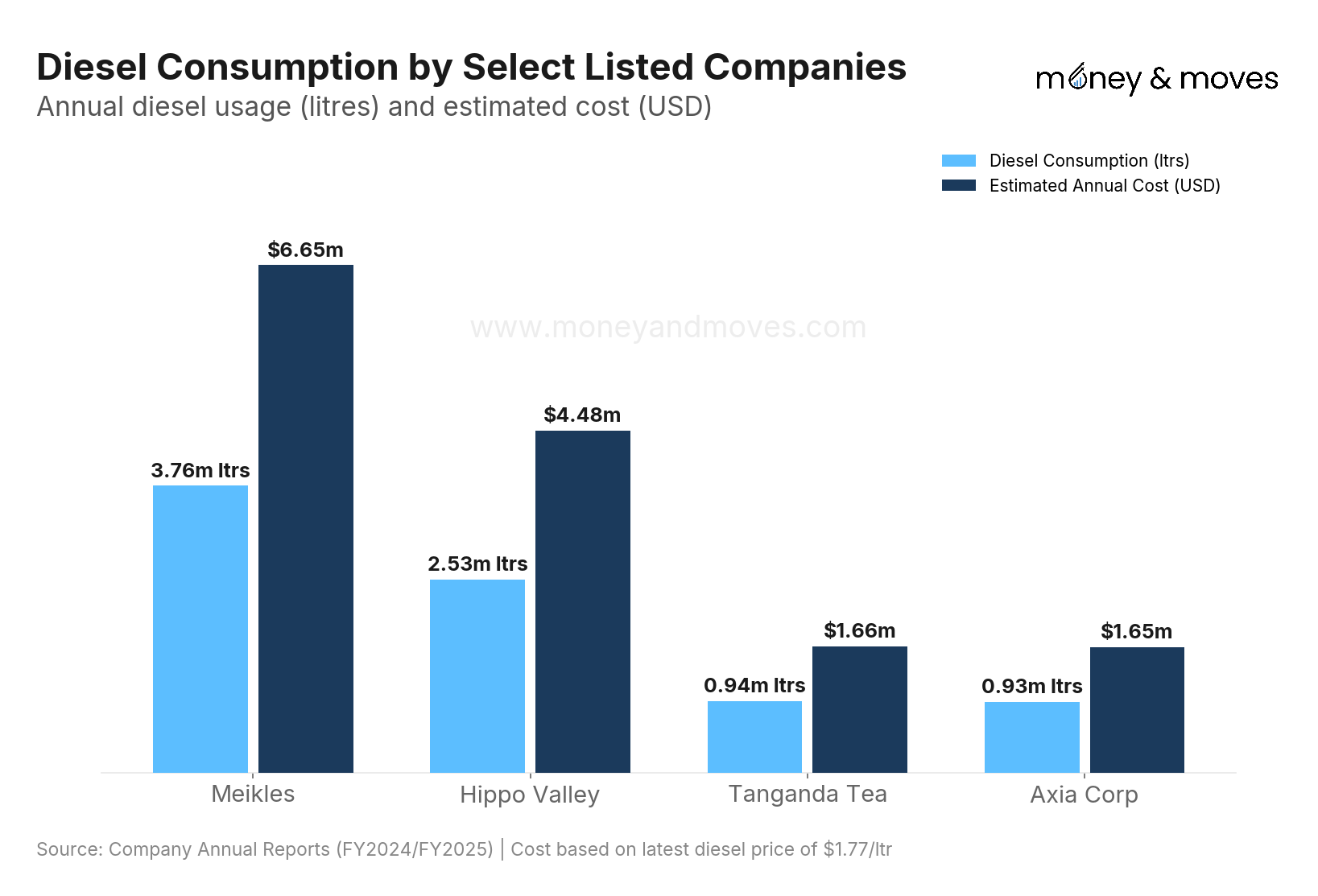
Meikles Limited, which owns Pick n Pay in Zimbabwe, reported using 3.76 million litres of diesel. At the new pump price of $1.77, this amounts to approximately $6.65 million annually.
That $6.65 million diesel would be more than the total profit it made back in 2014 when retailers were thriving.
A lot of times, fuel costs are just an assumed cost of doing business that you just eat up, but the war in Iran and its impact will make these costs hard to ignore for any business owner, executive or investor.
What’s Happening with Oil?
On 28 February, the US and Israel struck Iran. Since then, oil has spiked from about $70 to around $100 a barrel. That’s a 40% increase in about two weeks.
The Strait of Hormuz, where about 20% of the world’s oil passes through every day, was effectively shut down by Iran.
And well, you know, demand and supply kicked in.
The Maths That Should Worry You
Let’s walk through what this means for a company like Meikles.
In its most recent interim results, Meikles reported revenue of about 6 billion ZiG, roughly $200 million for the half. Annualised, that’s about $400 million in revenue.
If Meikles targets a 2% net profit margin (which would be good in the current environment), that gives you $8 million in profit.
A 50% increase in diesel prices would add roughly $3.3 million to the fuel bill. That’s nearly half of the $8 million gone. On diesel alone.
And remember, Meikles wasn’t even profitable in its last reported half.
This is just to illustrate how much impact a fuel price increase that could be coming might have on a business, even if it's doing well.
Now imagine a business that is struggling. On that note, spare a thought for Tanganda, which has a fuel bill the 20% the size of its market capitalisation.
In some ways, this feels like the early days of COVID. A crisis that seemed far away and distance could very soon have massive impact around the world.
Fuel impacts nearly every price and is likely to drive inflation, potentially causing significant operating challenges for companies.
Where’s the Money? What’s the Move?
Watch out for companies that have big fuel exposure in their business. What was supposed to be a good year financially could end up much worse than expected.
One sector that just got a boost: solar energy. It should be easier now than ever to explain the business case for cutting generator use as much as possible and shifting to solar. No wonder part of the money Tanganda is planning to raise with its rights issue is being allocated to solar.
What do you think?
Sources: Company Annual Reports (FY2024/FY2025). Diesel cost estimates based on the latest price of $1.77/ltr.
P.S. I am working with publicly available information, so I could be wrong or missing something. Thanks for reading!
And now we've crossed $2