



Two weeks ago, Old Mutual resumed trading on the Victoria Falls Stock Exchange in Zimbabwe after being suspended in 2020.
Why did this happen? What does it mean for the broader market? And what opportunities does it create for you?
Let’s unpack!

The History
Before we talk about what happened with Old Mutual two weeks ago, we need to go back nearly two hundred years, to 1845, when a Scotsman named John Fairbairn started The Mutual Life Assurance Society of the Cape of Good Hope in Cape Town.
The society had no capital other than the premiums of its first 166 policyholders.
At the time, Old Mutual was set up as a mutual society. A mutual society is a financial organisation owned entirely by its members, who are typically its customers or policyholders, rather than by outside shareholders on a stock exchange.
In simple terms, it’s a bit like a club that pools money together for the benefit of its members. And much like clubs, these societies tend to be not-for-profit.
That was the case for the next 150 years, until 1999, when Old Mutual decided to demutualise.
Demutualisation is the process of converting a member-owned, not-for-profit organisation into a for-profit, publicly traded company owned by shareholders.
One of the reasons societies demutualise is to raise external capital to fund growth. With a mutual society, your options for raising capital are limited, normally to borrowing from a bank.
A company, on the other hand, can issue shares and raise cheaper capital without having to worry about interest repayments.
However, to demutualise, Old Mutual needed to convert its policyholders into shareholders. That was not a simple task.
By then, Old Mutual operated in several countries, so it decided to list in the countries where it had the most policyholders, including South Africa, the UK, Zimbabwe, Namibia, and Malawi.
This way, people who were part of the Old Mutual “club” could be given shares, which they could then trade on a stock exchange.
That’s how Old Mutual ended up listed in Zimbabwe, and at the same time, it was listed in South Africa, the UK, Namibia, and Malawi.
This process also helped Old Mutual raise £356 million in new capital by issuing shares, something they would not have been able to do before.
It’s also worth clarifying that the Old Mutual listed in Zimbabwe is not Old Mutual Zimbabwe. It’s Old Mutual Limited, the whole group.
This small fact creates a few interesting dynamics.
Why Old Mutual Got Suspended from the Stock Exchange
As mentioned, the Zimbabwe listing is essentially a cross-listing of the global business.
Old Mutual’s primary listing is on the Johannesburg Stock Exchange in South Africa. A primary listing is the main stock exchange where a public company’s stock is traded. This is like the home ground of a football team. That’s where most of the activity is and where the main base is.
That said, all the shares are the same. One share in Zimbabwe carries the same claim on the company as one in South Africa or the UK.
These shares were also fungible, meaning that if you bought them in Zimbabwe, you could technically move them to the UK exchange and sell them there.
When hyperinflation hit Zimbabwe, that realisation gave rise to the Old Mutual implied rate. The idea was simple: if Old Mutual shares in Zimbabwe were trading for, say, 100,000 Zimbabwe dollars, and the same shares in the UK were trading at £1, then the “implied exchange rate” would be £1 to ZWD 100,000.
This became widely used as a benchmark for the unofficial exchange, and while the companies themselves had nothing to do with it, the rate was perceived to be fueling parallel market activity.
Here is some reporting by the Herald at the time of the suspension:
Old Mutual will remain suspended after authorities said there was reasonable ground for dual listed counters, including another Johannesburg Stock Exchange listed entity PPC Limited to remain suspended.
“Whilst there was no observed evidence of the direct involvement of the listed entities themselves, significant evidence of a strong link between the price behaviours and transaction patterns on the internationally listed shares, namely Old Mutual, Seedco International and PPC Limited, and the behaviour of the parallel market exchange rate was also established, with varying degrees of causality,” reads part of the statement signed by the Finance Minister Prof Mthuli Ncube.
The Return
On 12 August, six years after the ban, Old Mutual’s suspension was lifted, and the stock migrated to the USD-denominated VFEX, with its shares resuming trading.
This was good news for the stock market and a positive development overall for several reasons.
Firstly, for shareholders, this was a long wait. The reason people buy shares on the stock exchange is that they can trade them. Not being able to do that for six years was a dark cloud over the stock market.
Linked to the first point, the lifting of the suspension is a positive signal that after years of volatility, Zimbabwe is trying to normalise. A stock suspended for six years was not normal.
Then it’s also good for the stock exchange, especially since there have been a few delistings; the more stocks that list, the better for trading and the capital markets.
Old Mutual’s listing also helped boost the VFEX exchange’s market cap from about $4 billion to $8 billion…sort of. Let me explain.
How VFEX’s Market Cap Suddenly Doubled
Closely following Old Mutual’s return came a new approach to how the VFEX and ZSE calculate market capitalisation, which meant that after Old Mutual relisted, the VFEX market cap went from about $4 billion to $8 billion.
Market capitalisation (market cap) is basically the number of shares multiplied by the share price.
In the past, that was measured using only the shares trading in Zimbabwe. Take Old Mutual as an example. The stock is listed in five countries.
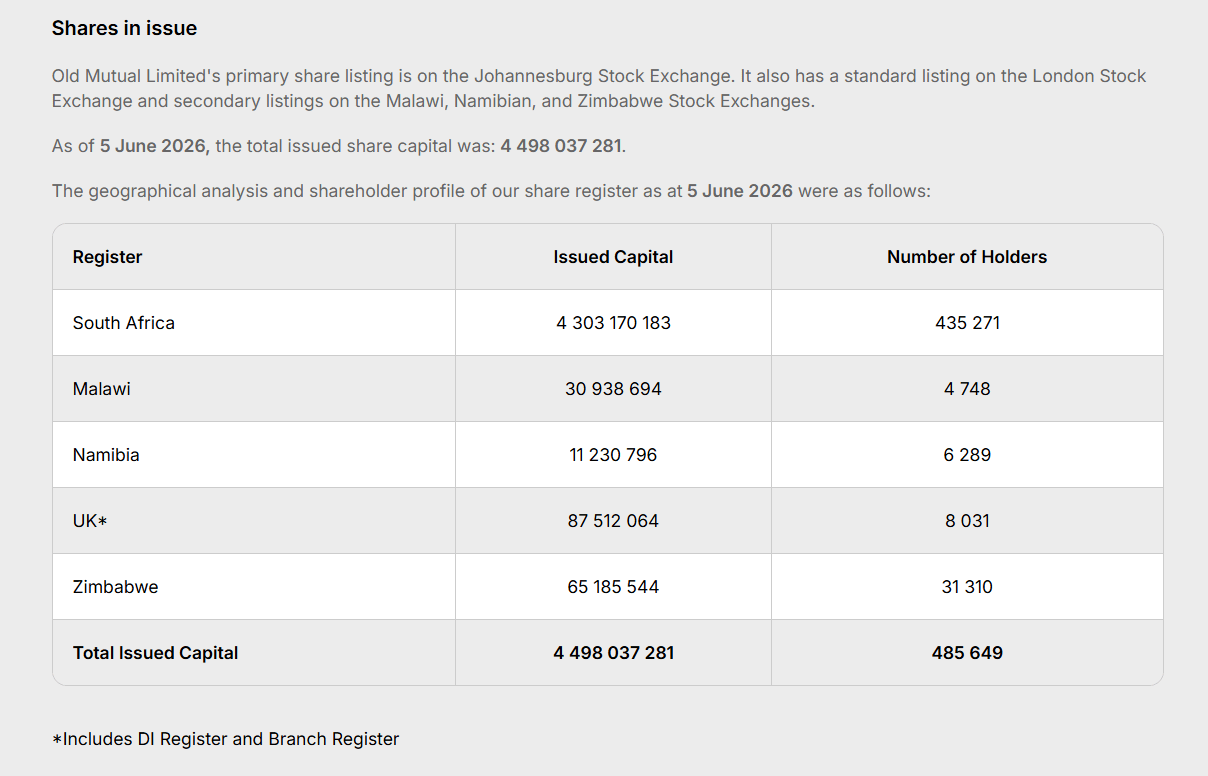
Old Mutual has 65,185,544 shares issued in Zimbabwe.
Using the old approach, the market cap of Old Mutual on the VFEX would be 65 million shares multiplied by today’s share price of about $0.90, which comes to roughly $ 58.5 million.
The other approach is to take the total number of shares in issue globally, about 4.5 billion, and multiply it by the share price. That gives you a market cap of roughly $4 billion.
You can see how much of a difference that change makes. In this case, it’s nearly 70 times more.
This is also why the second approach isn’t always desirable. It’s not a good reflection of the actual size of the stock exchange, because you can only actually trade $58.7 million worth of shares.
On the other hand, many stock exchanges use this global approach.
South Africa’s stock exchange, the largest in Africa, is often cited as having a market cap of $1.5 trillion, nearly half the continent’s GDP. But that figure includes dual listings.
If you count only the shares with primary listings in South Africa, that figure drops to under $600 billion. Still impressive, but nowhere near as big.
Since market caps are often how exchanges get measured, I can see the logic in the ZSE and VFEX shifting the basis to get a bigger number, from a marketing and narrative point of view.
But in reality, a real operational metric for evaluating growth should be the number of shares actually traded in the market. If that number doesn’t increase, the market is not actually getting bigger.
That said, even as things stand, dual listing does create an opportunity for investors as long as you have the right strategy.
Speaking of strategy, one of the biggest mistakes companies make when developing their strategy is only looking inward.
This is very common among companies that have failed and lost millions. In most cases, an outside party, unhindered by internal dynamics and biases, could have helped pinpoint unseen risks and opportunities.
If you are planning a strategy session and want a data-driven, outside view of your business, the economy or the market — reply to this email or message me here.
In the meantime, here are pointers to consider when strategising what moves you can make when looking at Old Mutual’s stock.
Where’s the Money? What’s the Move?
In theory, the price of Old Mutual’s share should be the same everywhere, with the only difference being the exchange rate, since one share in Zimbabwe carries the same claim as one share in South Africa or the UK.
At present, Old Mutual in South Africa is trading at R12.68, which converts to $0.79 at today’s exchange rate. The same shares in the UK are trading at GBP 0.58, which is also $0.79 at today’s exchange rate. Exactly the same.
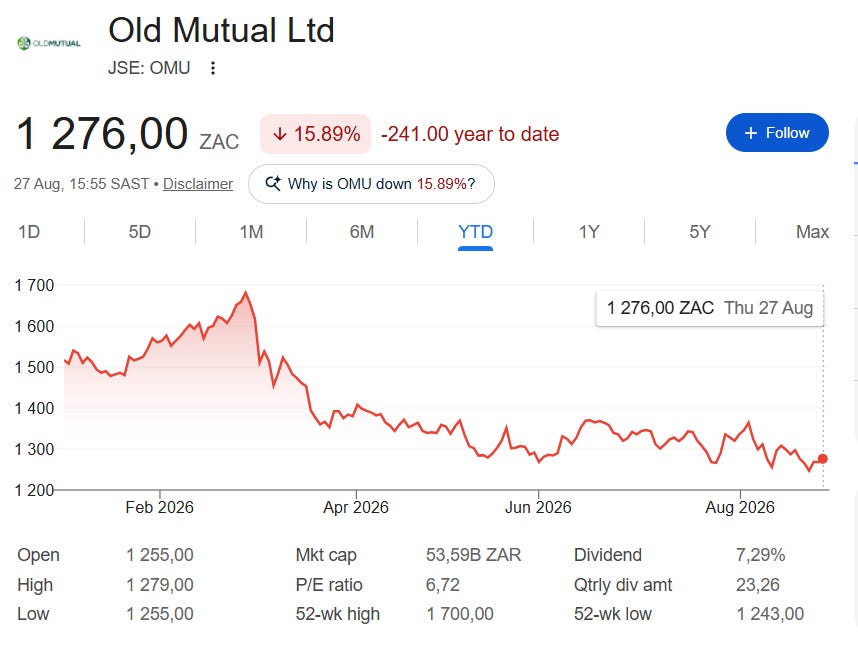
However, Old Mutual’s share price today is $ 0.90, noticeably higher.
Why?
One reason is the interplay of demand, supply, and access to international markets.
We must never forget that what ultimately drives stock prices up is demand exceeding supply at a given price. Simply put, stocks go up because people buy them.
In Zimbabwe, Old Mutual is attractive because you get access to a business generating cash flows in South Africa. This helps diversify risk, which is always valuable.
In other markets, it's much easier to do that, as you can invest in international stocks; however, Zimbabwe still has the overhang of the past, so buying stocks offshore is not as easy.
So there is a premium that comes with that. An SA stock listed in Zimbabwe.
This dual-listing premium is also neither new nor unique. Currently, Caledonia is listed on the VFEX and the New York Stock Exchange. In the US, the stock traded at $24.95. In Zimbabwe, the same stock was trading at $32.04.
In this case, however, exposure to Zimbabwe remains the same, as Caledonia’s main operations are in Zimbabwe, but even then, there is a premium.
Then there is also the blue chip premium. The stock exchange in Zimbabwe is still fairly small, so there aren't that many stocks to choose from. When an Old Mutual comes along, many people would be interested in investing.
It also helps that Old Mutual’s share price is currently depressed, down 16% YTD, and that it has a dividend yield of 7.3%, or about 6.2% when adjusted for the stock's price in Zimbabwe.
On that basis alone, one could consider it a decent investment.
The other elements that can drive up the price are FOMO (Fear Of Missing Out).
This is more common in the stock markets than you would think.
People see the Old Mutual share price on the VFEX going up, think they should probably buy some, and the price goes up even more. Which makes them want to buy more.
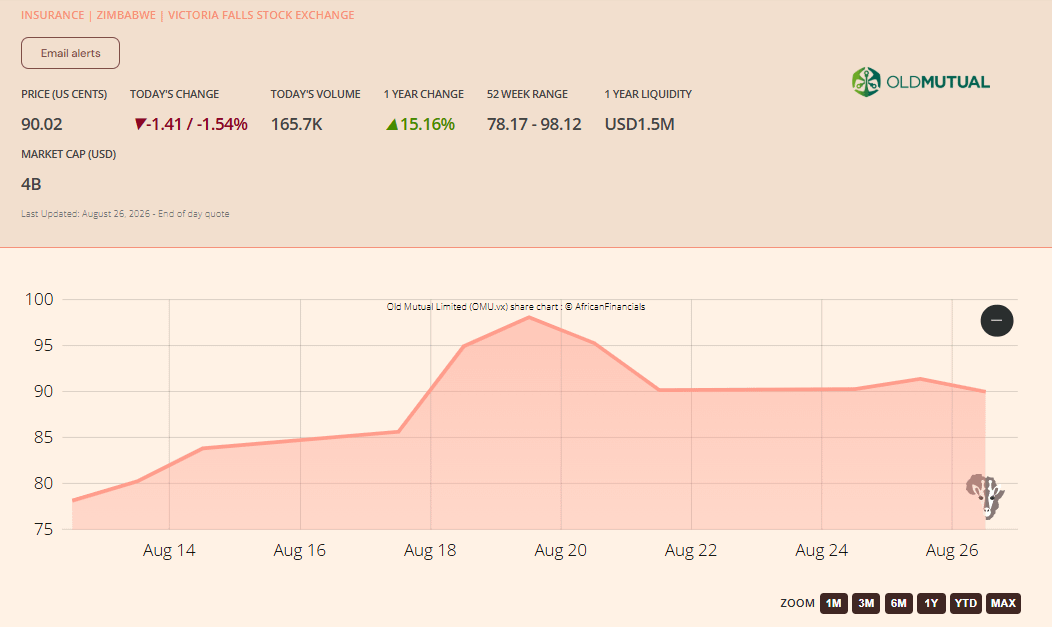
Then the people who have already bought feel they made a really good investment and don’t want to sell the stock, which decreases the supply of sellers while demand increases, so the price goes up.
In a market like Zimbabwe, where you have about 20 stocks to choose from on the VFEX, this can easily happen. That’s why, at times, stocks have high paper valuations but very few trades.
But before you also get hit with FOMO, here are some technical factors to consider.
When you buy an Old Mutual share on the VFEX today, you’re also converting USD to ZAR in a sense, since Old Mutual on the VFEX is listed in USD, but the dividends you’ll be paid are in rand, which are converted to USD.
So if the rand weakens, say in an extreme case to R20:$1, then the share you bought at R12.68, worth $0.79 at the time, is now technically worth $0.63.
The opposite could also happen. If the rand suddenly rallied to R10:$1, your stock would be worth $1.29.
Swings that big don’t normally happen, but it’s worth being alert to the FX impact.
The other factor is that if there’s a sharp move on the South African market due to major news, it may take time for the Zimbabwe exchange to catch up.
This happens more than you’d imagine in the Zimbabwean context.
Even with Edgars, after the delisting circular stated that if you had shares in Edgars, you would be paid 2.48 cents per share to facilitate the delisting, people were still selling their shares for 2.00 cents in the market rather than holding out for the higher price, which is near certain.

Granted, the volumes are small, but it shows that the market in Zimbabwe is still not fully efficient. News happens, and some people only realise it much later.
And inefficiency like that creates opportunities, especially in special situations. If you are quick to make a move, you can make some strong returns in a short period.
What do you think?
PS: I am working with publicly available information, so I could be missing something or just wrong. This is not financial advice, so do your own research.
On the issue of higher price here in Zim, won't it lead to arbitrage trading whereby 1 would buy Caledonia shares in US at a lower price and sale them at the VFX at a higher price and pocket the difference?
Thumbs up! Once tried do the arbitrage thing years back .Buying ex SA and repatriating to Zim