


The importance of gold to the Zimbabwean economy cannot be overstated. Gold is currently Zimbabwe’s biggest export, making up over 50% of all export earnings. It is also a large employer, as 70% to 75% of output is from artisanal or small scale miners.
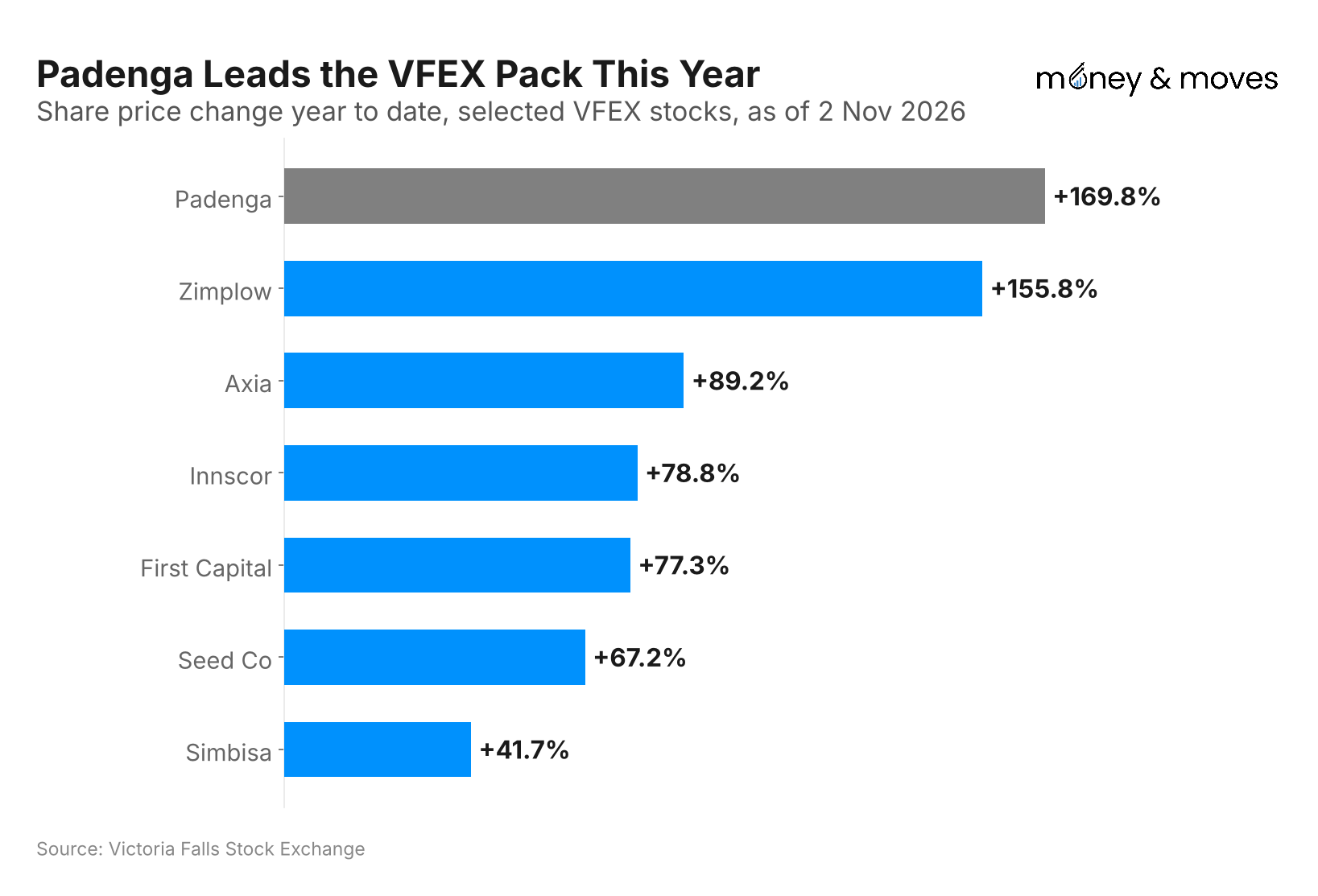
The best performing stock on the VFEX has been gold producer Padenga, which is up 170% since the beginning of the year.
A lot of the improved economic performance can be linked to gold.
While the increase has been driven by higher gold production, what made the most difference is the price, which has effectively doubled since 2024 and hit record highs.
With just 28% more gold, the value of gold export receipts increased 84%.
To put that into perspective, the 46.7 tonnes Zimbabwe produced in 2025 is about 1.5 million ounces. That gives us a rule of thumb: every $100 move in gold is roughly US$150 million a year in export value at 2025 volumes.
So with the gold price being so important for the economy and business in general, where do we think the gold price will be next year?
Let’s unpack!
Forecasting the Gold Price
Forecasting the gold price is incredibly difficult. Most models rely on what will happen with interest rates and the US dollar, and both are hard to predict, and other factors such as central bank buying and investor flows are even harder to read.
To illustrate this, the table below shows the gold price forecast that Goldman Sachs held going into each year, and what happened with the gold price.
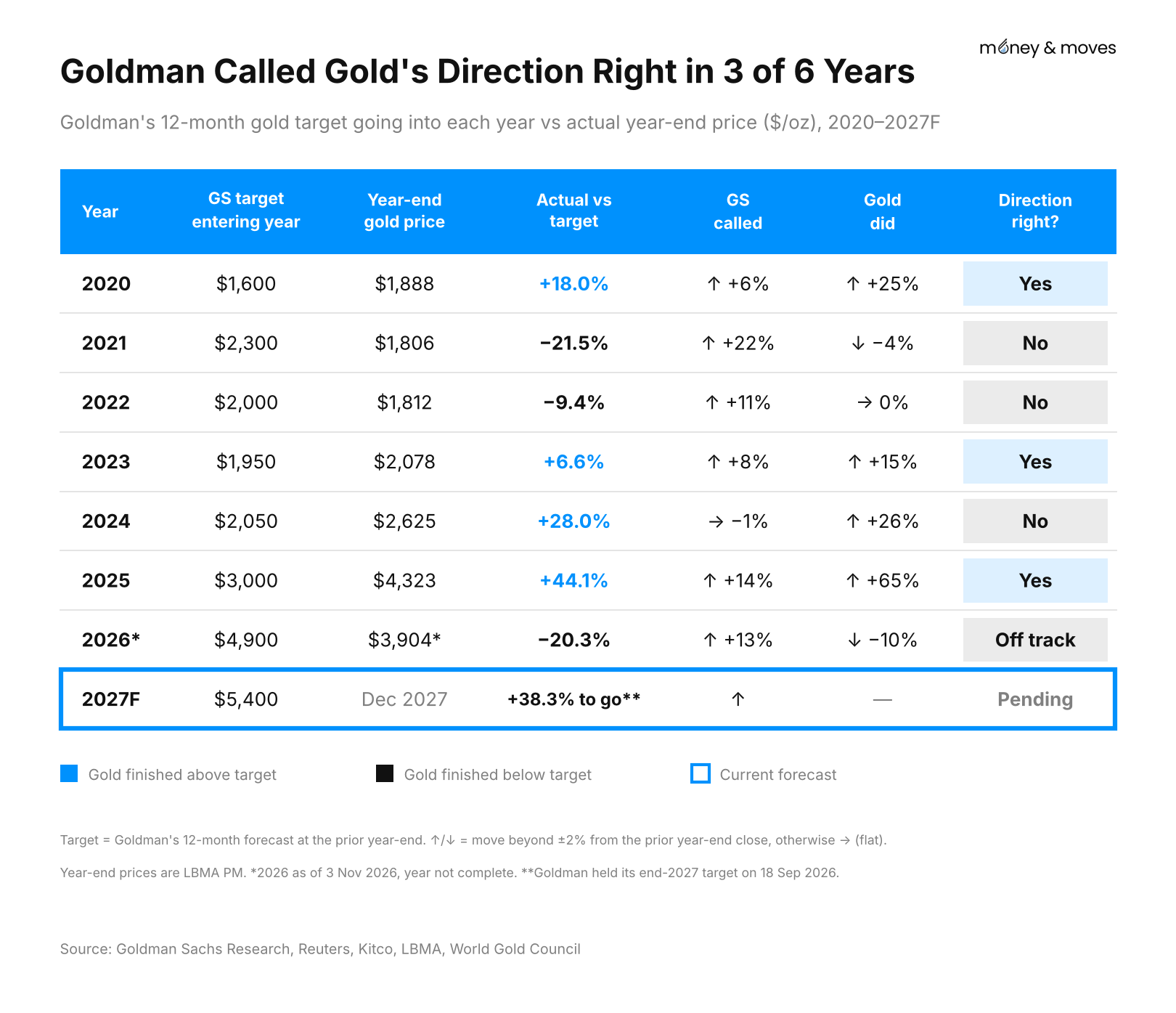
As you can see, Goldman Sachs had the direction correct half of the time, despite being one of the most knowledgeable on the subject. Also, in the cases where the direction was correct, there have been big swings from the forecast.
To reiterate, this doesn’t mean that Goldman Sachs is not good at forecasting. They frequently update their forecasts during the year, and the above was based on the forecast closest to the end of the year.
It just highlights how challenging it is trying to predict gold prices even a year in advance.
However, even with this there are a few insights we can draw.
The Trump Effect
One can see the impact of Trump coming into office in 2025. As we’ve talked about before, it seems that the “predictably unpredictable” nature of Trump has generally helped gold rally, as the dollar weakened, central banks bought more gold and investors looked for safe haven assets.
In 2026, however, gold has performed weaker than expected. This can be attributed to the Iran war, which meant oil prices went up, which meant the costs of goods went up and, as a result, inflation went up.
When inflation rises, the Federal Reserve (the equivalent of the Reserve Bank) typically increases interest rates, to try to contain inflation. In September, the Fed raised rates for the first time in three years.
This increase in interest rates makes gold less attractive. Gold does not give you an interest payment, so the opportunity cost of holding gold gets bigger when interest rates rise.
So this has probably contributed to the pressure on the gold price, and currently it looks like there will be more rate hikes this year and the next, which have the same effect. Goldman has cut its end-2026 target for gold to $4,650, but kept $5,400 for the end of 2027.
The other thing to consider is if Trump through his actions and policies was in some way a catalyst for the gold price to rally, does that also mean that if Trump starts losing power the gold price will also soften?
The US just held its midterm elections, which come midway through the presidential term and decide how much the president can do in his last two years.
The Democrats beat the Republicans convincingly, in what many see as a rejection of the Trump administration. In the long run, could this be bad for gold?
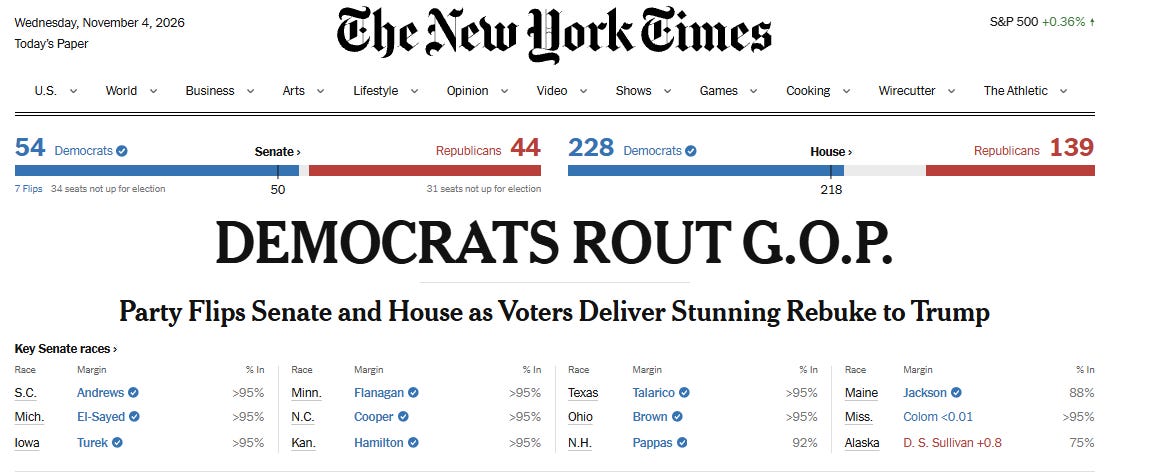
For now, gold is rising on the news.
This seems partly because investors expect Trump to react to the loss in a more unpredictable, confrontational way, increasing demand for gold as a safe haven.
Here is a New York Times article that argues this idea that the midterm loss will make Trump even more confrontational.
Either way, it remains to be seen what will happen, but it’s worth looking at both scenarios.
Two Scenarios: Gold Falls or Gold Rises
What Happens If the Price Falls
If the price falls sharply, there are a few big changes.
Export earnings drop. Say gold slides from today’s $4,000 to $3,000. That is a $1,000 drop, or tent times the rule of thumb we came up with earlier. At 2025 volumes, that is roughly US$1.5 billion a year less, almost 33% of the US$4.64 billion gold earned in 2025. The economy will definitely feel that.
The most obvious hit is that tax revenue will be lower, especially in royalties and in corporate and income tax, as gold miners’ profitability has been a big contributor.
The knock-on effects could mean consumer staples, which have been growing incredibly fast, could also slow. It’s hard to know how much consumer spending can be linked directly or indirectly to miners. But with about 75% of output coming from small scale miners, when their income falls, so does what they spend on groceries and basics.
What Happens If the Price Rises
Goldman Sachs forecasts gold at $5,400 by the end of 2027, about 38% above today’s price. That is a $1,496 move, roughly 15 times the rule of thumb. At 2025 volumes, it adds up to about US$2.2 billion a year in extra export earnings. That would be a very attractive price. It is still a forecast, and as the table shows, Goldman’s forecasts are not guaranteed.
Gold stocks will continue to do well. Mining costs do not rise as fast as the price, so profits move faster than gold does. Padenga’s first-half earnings per share rose 217% in a rising market.
The appetite for investing in gold will increase. That should bring more capital into a sector where most of the output comes from small scale miners.
The economy will certainly benefit. More export dollars coming in should help economic growth hold up.
Overall, I think the gold price is one to pay attention to.
I still hold to the theory, however, that the single most important topic in Zimbabwe that will determine how next year will go is the stability of the currency and managing hyperinflation.
The gold price and the impending drought are factors, but I think those can be managed, whereas a currency collapse cannot.
Where’s the Money? What’s the Move?
For investors, it will be interesting to watch how the gold price impacts companies like Padenga, especially if there is a pull back.
Gold stocks are much harder to analyse, and in the local market there isn’t much dedicated expertise when it comes to analysing the price of a stock in mining, like there is in the US for example.
So while Padenga has gone up 170% this year, Caledonia, the other gold stock, is down 19%. A lot of this is operational improvements: Padenga had exceptional half-year results at the end of June, with profit tripling.
However, I think this is also due to the fact that Caledonia, since it is listed in the US and the UK, has more expert analyst coverage on the stock, and so all the risks are properly priced in.
Padenga, on the other hand, is only listed in Zimbabwe, and so with the performance of gold and the stock, the demand for exposure in Padenga is at record highs. I am not sure if all the risks have been priced in. If gold drops, will the stock have a sharp correction?
If the gold price continues to go up, no problem, but what is a problem is if the gold price starts dropping.
For now, Goldman Sachs’ latest public note has gold reaching $5,400 by the end of 2027. This forecast is probably going to be updated soon, and it’s one to look out for, but this is a reference point worth keeping an eye on.
Thanks for reading. If you found this insightful, share it with someone and help them make a better decision.
Note: For educational and informational purposes only. This is not investment advice, a recommendation, or an offer to buy or sell any security. Do your own research and consult a licensed financial advisor before making investment decisions.
Note: How the Numbers Were Calculated
Target and price. Goldman’s target used was the 12-month or end of the following year forecast that was published closest to year end. Actual prices are year-end gold (LBMA PM). For 2026, I used a price of $3,903.8 (3 November).
Direction. A move counted as up or down only if it was more than 2% from the last year’s price, otherwise it was considered flat. Goldman Sachs was deemed right when its forecast move matched the direction of the actual move.
The Rule of thumb. 46.7 tonnes is about 1.5 million ounces, so every $100 move is about US$150 million a year at 2025 volumes.
AI was used to research these numbers, which were cross-checked against Claude and Gemini. As a manual check, we opened and read the articles citing the prices for the key figures shown.
Good read.