


“Formal retail is a bad business to be in.”
That’s been one of the most repeated lines in Zimbabwean business commentary over the last few years. And there has been good reason to believe it.
OK Zimbabwe, once the country’s biggest retailer, raised $20 million in mid-2025 to keep itself afloat. By February 2026, it was in corporate rescue. Truworths was effectively sold for $1 after entering corporate rescue. Choppies exited the Zimbabwean market entirely. TM Pick n Pay had a loss of roughly $2 million on its Zimbabwe operations.
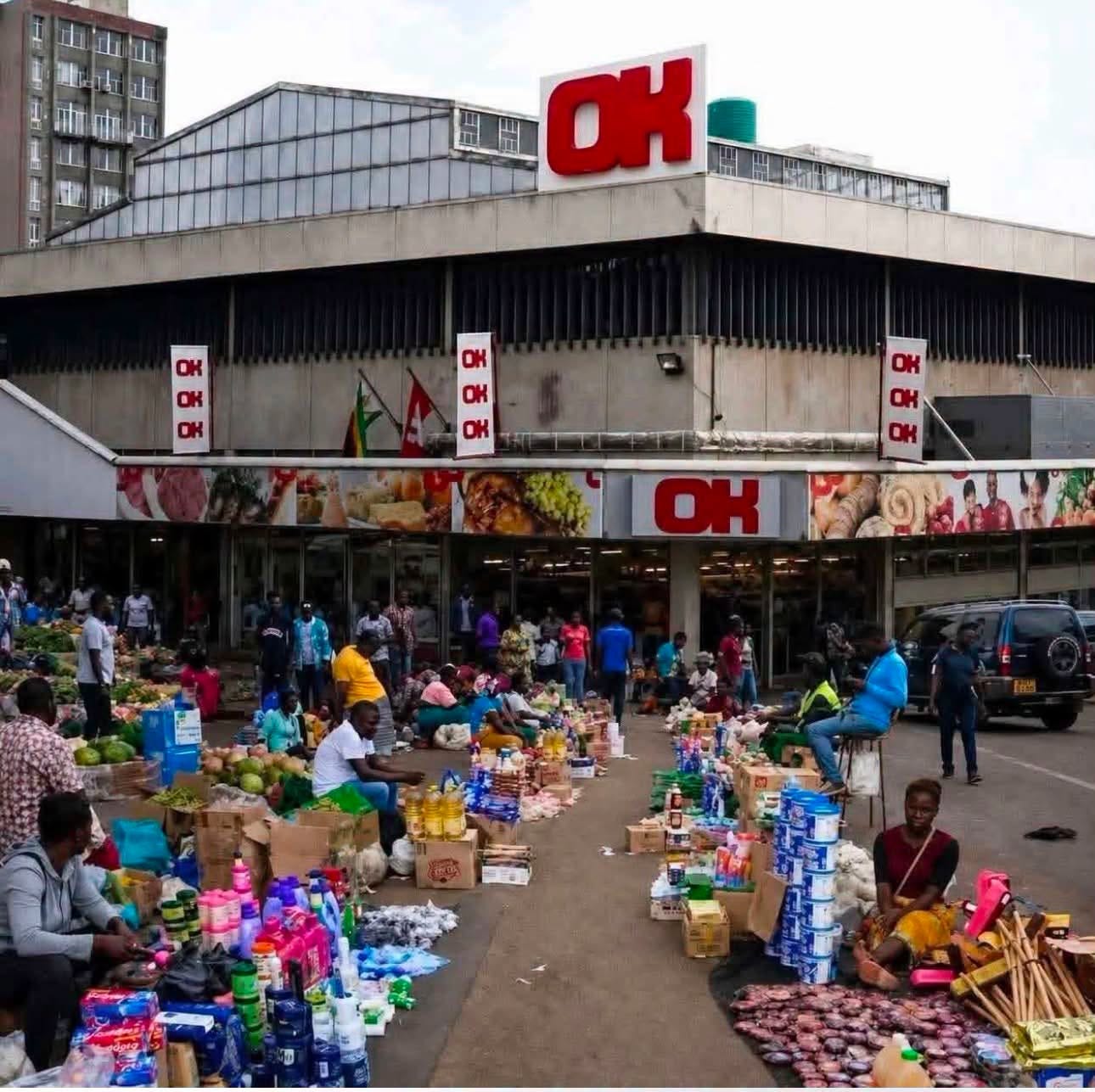
The picture below is now famous and has become the poster for why formal retail can’t compete. How is a store paying rent, staff, and tax supposed to win against informal traders?
That all made sense. Until Edgars’ latest financial results complicated the story.
While Edgars is preparing to delist from the stock exchange, the business just had one of its best years in a while. Is it possible retail isn’t the dead end everyone assumed?
Let’s unpack!
Last Year, Everyone Was Losing
When we looked at formal retailers last year, the picture was bleak. Every listed formal retailer had lost significant value since peaking in 2014.
TM Pick n Pay was the best of the bunch, and even they were still loss-making.

The biggest problem retailers faced was currency. Nearly every other sector was collecting US dollars.
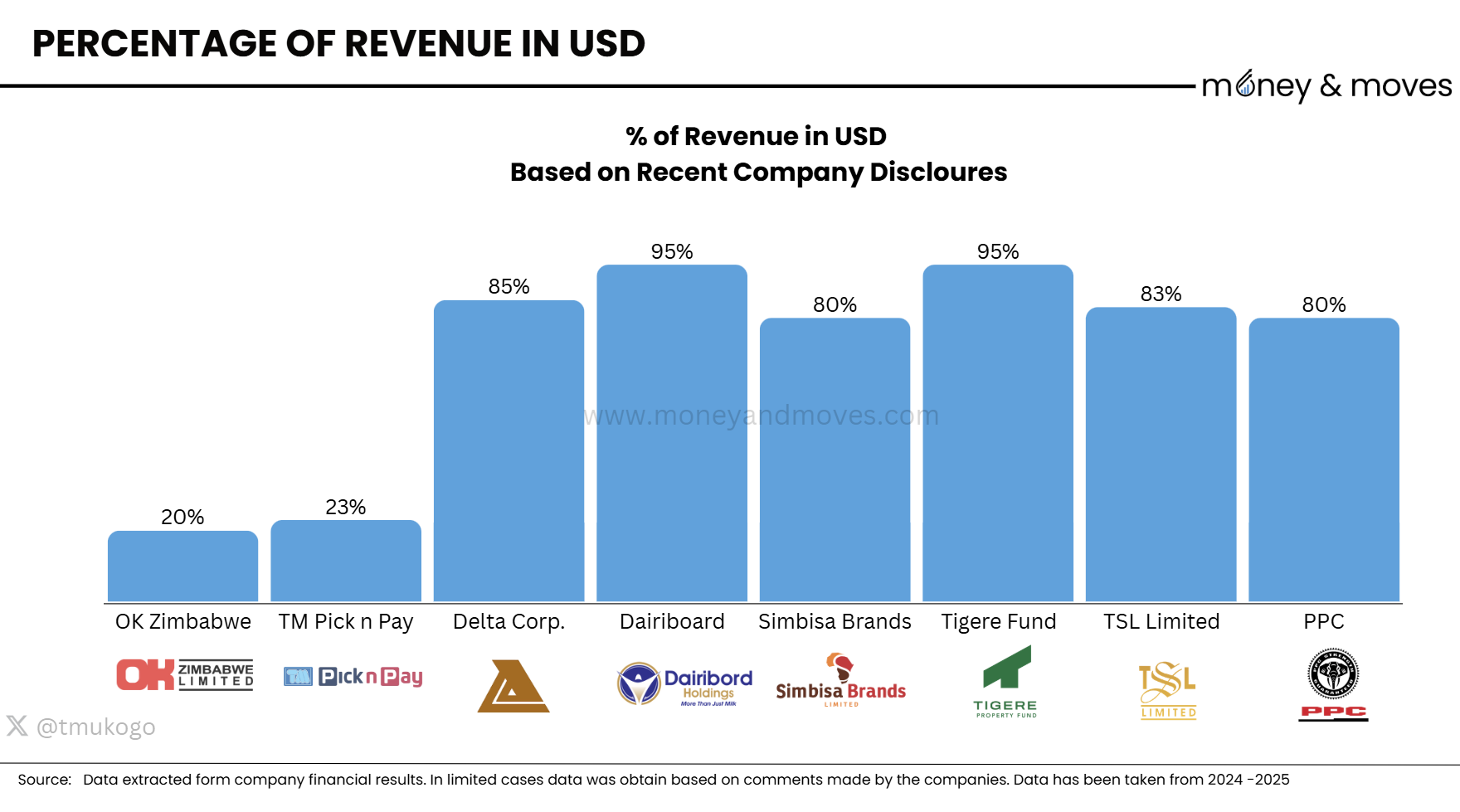
Retailers were mostly stuck with local currency, as shown in another chart we presented last year.
While most companies had over 80% of their sales in USD, retailers had about 20%. That was difficult to manage amid the general fear that the currency would lose value.
Since then, the ZiG has held value fairly well, which should have made business much easier.
But their performance in the numbers didn't show the improvement. If anything, the opposite happened. OKZ’s collapse became final, and TM Pick n Pay’s results stayed uninspiring, raking up losses.
Aside from the speciality retail segment, the retail sector has struggled overall.
Note: Speciality retail refers to goods that require some knowledge before purchase, unlike general retail, where the consumer usually already knows what they want. Think of buying a replacement car battery versus a T-shirt, or milk and eggs or a hardware store vs a grocery store.
Now, however, there is a data point worth looking at in the retail space.
Edgars’ Results
When Edgars reported its prior set of results, the article I wrote was titled “Selling Ice Cream in Winter.” The point was that despite putting in a lot of effort and spending on marketing and sales, revenue had still gone down.
It seemed the management team was working incredibly hard, but it was like someone selling ice cream on a freezing winter day.
That’s no longer the story.
Revenue increased 12% to $34 million, while selling expenses rose only 5%. On its own, 12% growth in this economy might not sound like much. But it’s worth remembering that just a year earlier, revenue had dropped 9% while selling expenses increased.
This is a big improvement.
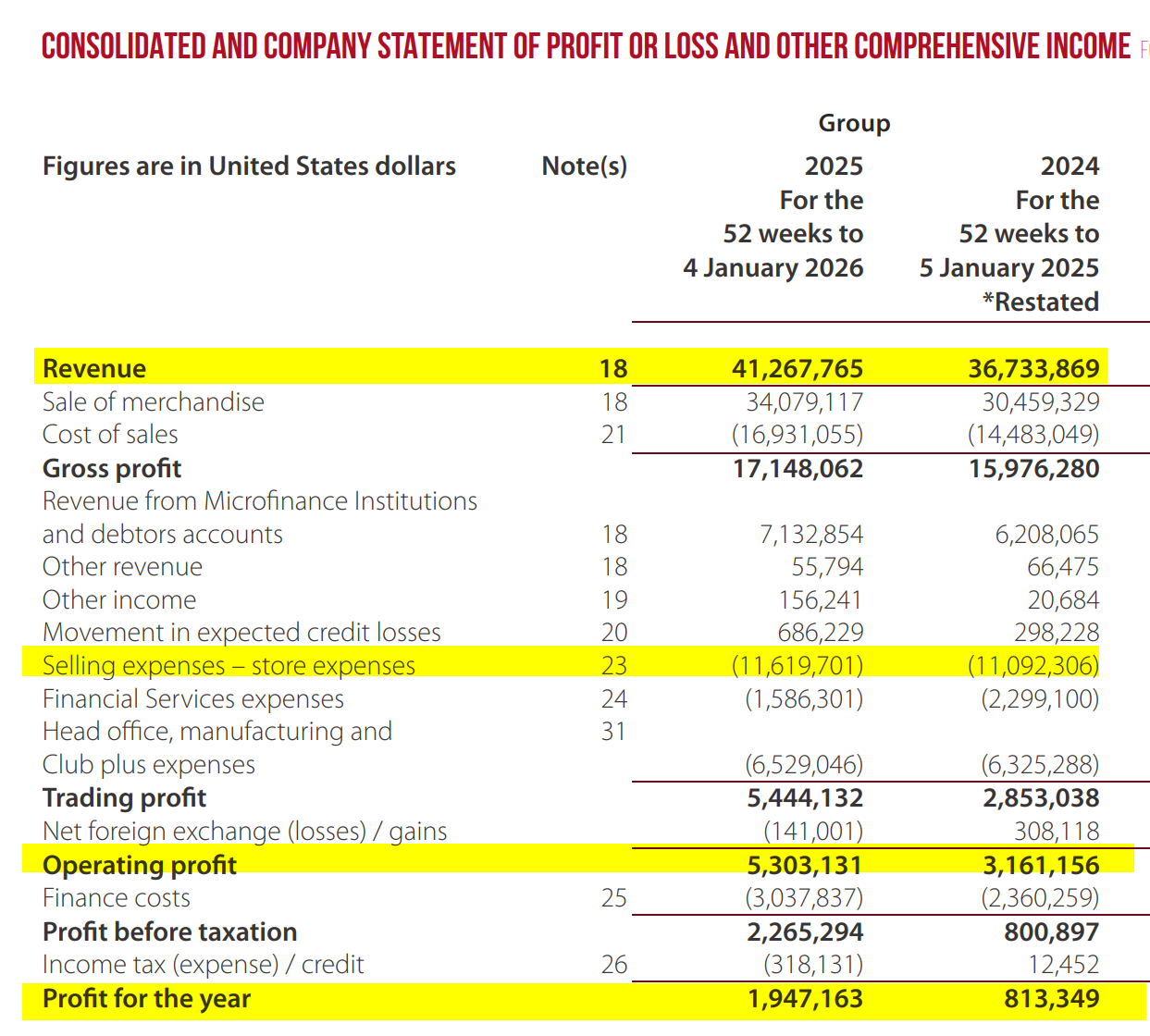
Notably, the improvement was broad, not concentrated in one part of the business.
Edgars operates two retail brands: Edgars Chain, which targets the middle-to upper-income groups, and Jet, which targets the lower- to middle-income groups.
The results were nearly identical. Both recorded strong revenue growth of 10.24% and 10.19%, respectively, and generated operating margins of 8.4% and 9.0%.
When two segments serving different income groups improve uniformly, it’s a sign of structural change across the whole business, not just one business segment that’s booming.
What Changed
The first thing that helped, and the one you’d expect, is the return of credit.
Dollarisation and ZiG stability have made extending credit much easier than it was three years ago, and consumer credit is a genuinely profitable business.
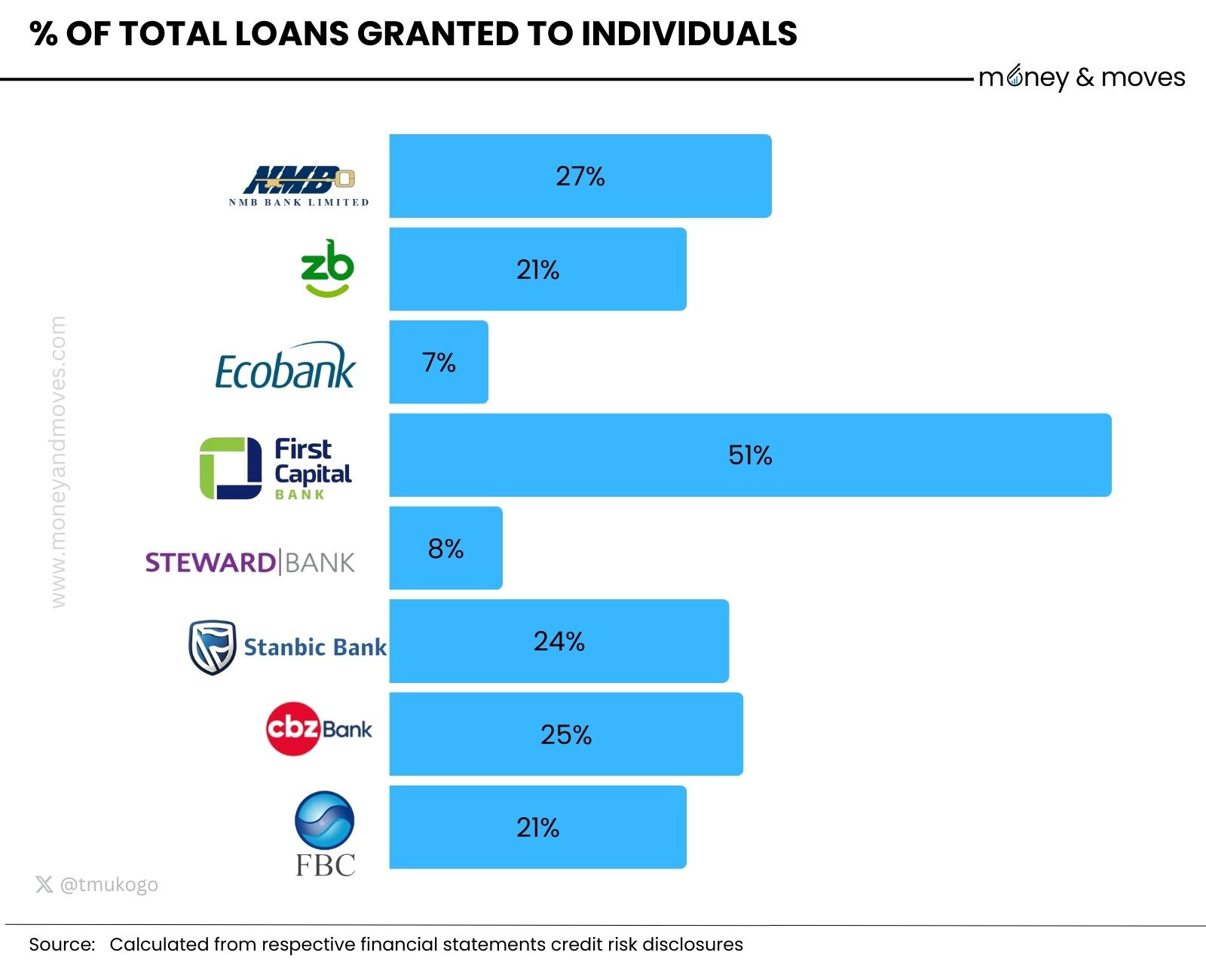
First Capital Bank’s strong recent performance is anchored on exactly this kind of individual lending, an area most Zimbabwean banks have not focused on.
The numbers suggest that Edgars is making the most of the opportunity. Edgars’ USD retail debtors’ book grew 8.6% to $12.6 million. Credit limit utilisation, essentially how much of the available credit customers are actually using, improved to 30.6% from just 16.8% the year before.
At the same time, the loan book got cleaner. Overdue accounts fell to 14.5% from 16.9%, and expected credit losses dropped to 3.5% of the book from 5.4%.
This improvement showed in the profit. Group operating profit was $5.3 million, and nearly half of that, 47%, came from the finance business.
But finance alone doesn’t explain everything. The business had to change its approach to get more people to buy, and what makes the most sense to me is pricing and selection.
After visiting some stores, Edgars still appears to be more expensive than buying from South Africa; however, the gap has narrowed significantly. Enough that someone might just buy locally instead of waiting for their next trip across the border.
This also applies to informal traders. As the price gap narrows, the incentive to shop elsewhere is diminishing, and it seems customers are coming back.
This price vs brand split tracks with what we found when comparing Delta Corporation’s Coke and Varun Beverages’ Pepsi Offering: Zimbabweans are price-sensitive, but they’re also brand-loyal or brand-conscious.
You don’t have to be the cheapest; you just have to have a strong brand and be cheap enough.
All this raises an uncomfortable question for other retailers.
If Edgars could narrow that gap and become more competitive, what’s holding other retailers back?
To be fair, the clothing sector has also had some help.
In August 2025, the government banned the importation and sale of second-hand clothing, a move that probably helped build demand. This also shows how policymakers can help facilitate business growth, but ultimately, Edgars still had to reduce prices to capture that demand.
Interestingly, despite higher revenue and better performance, the number of corporate (head office) employees actually fell from 306 in FY2023 to 239 in FY2025. It’s hard to know the full picture without more detail, but it wouldn’t be the first company to grow too top-heavy and find it could perform better with a leaner head office.
Is this something other companies need to look at?
All this doesn't mean that formal retail isn’t challenging, but it does suggest that, for some of these companies, the story may no longer just be about the environment but also about the company's execution.
Edgars faced the same challenges as all other retailers, so if it’s showing some life, shouldn’t that also be happening with others?
Where’s the Money? What’s the Move?
There's a question Peter Thiel is famous for asking in interviews: What important truth do very few people agree with you on?
The idea is that the best opportunities aren’t the obvious ones everyone already sees and agrees with.
If you spot a gap that looks unattractive to everyone else but is, in reality, an opportunity you can win with almost no competition and get outsized returns if it pays off.
Mo Ibrahim ran into this exact situation when he tried to launch Celtel in the late 1990s. Western banks and investors told him people in Africa living on less than a dollar a day couldn’t afford mobile phones.
He thought otherwise.
Within six years, Celtel had expanded across multiple African countries, reaching millions of subscribers, and MTC Kuwait acquired it for $3.4 billion in 2005.
With that in mind, could formal retail in Zimbabwe be the next thing everyone has written off that actually has an opportunity hiding inside it?
Perhaps Edgars’ recent results and its plan to delist and exit the stock exchange both point to an opportunity that some have overlooked.
To be clear, I do think Edgars still has a lot to do and is probably not yet as strong a business as other blue-chip businesses, but the progress made means it’s one to watch.
There’s more to unpack, especially on the mechanics of the delisting and what it means for shareholders. But we’ll save that for another day. What do you think?
Thanks for reading.
P.S. I am working with publicly available information, so I could be wrong or missing something.
The formal retail is entering an unchartered territory considering the modern structure in Zimbabwe where the Informal sector holds most of the demand
Good move Edgars by the way . Honestly the stock price wasn't going anywhere
The credit purchase system is going to see see most retailers recording improvements, I see that some mobile phone retailers have also taken up that model, soon we might actually see big brand franchises enter the market