



The last 20 years have been tough for Zimbabwe’s capital markets. The chart below shows it clearly. Most of the activity has been companies leaving.
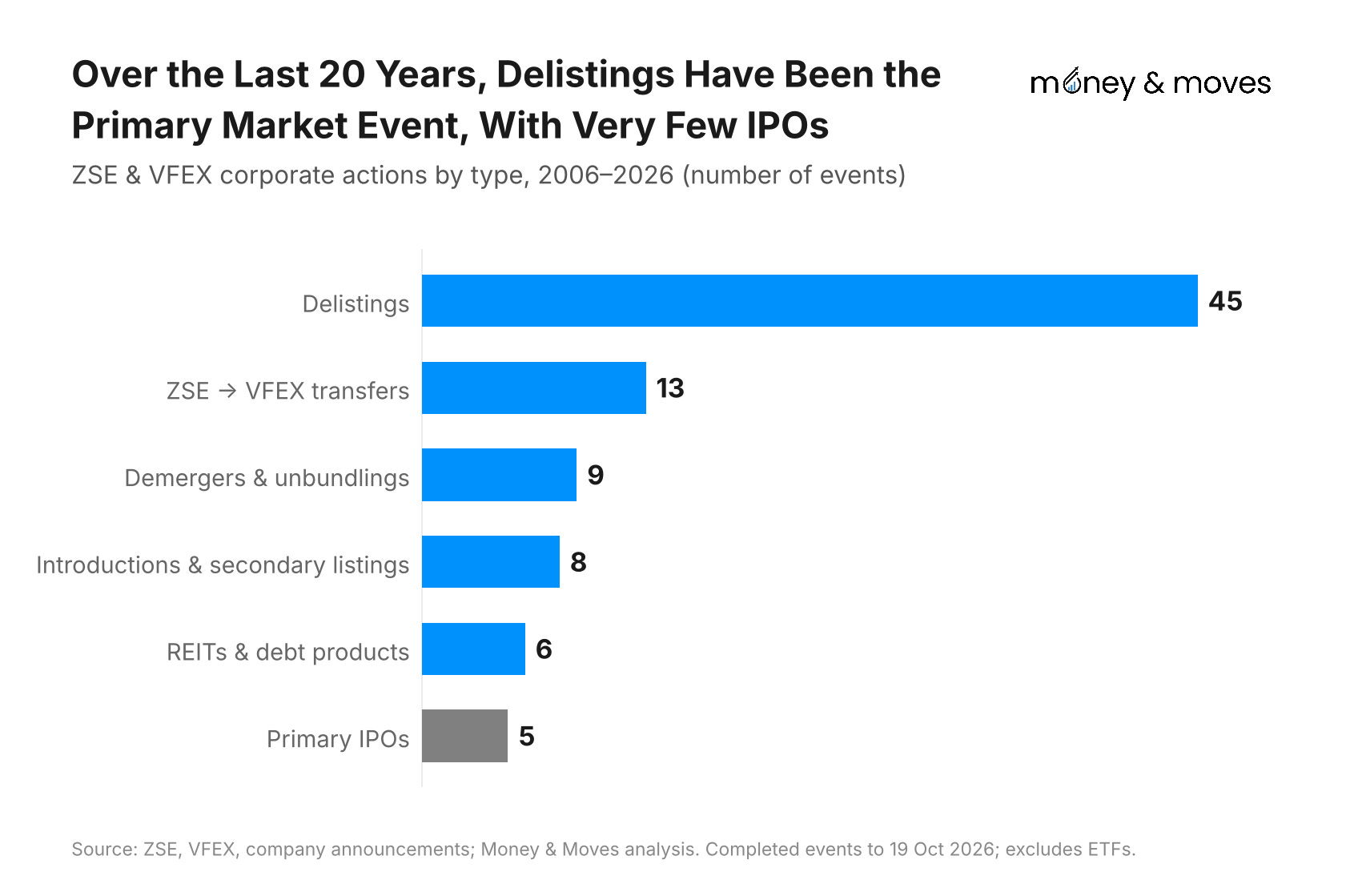
There have been 45 delistings and only 5 IPOs (excluding REITs). Most of those IPOs happened before 2010.
That is why Amalgamated Brands is one to watch. After GetBucks in 2016 and WestProp in 2023, it is only the third company to IPO in 15 years, and it could be an important market signal, especially when you understand who is selling in this IPO.
Understanding this is key if you are an entrepreneur, executive or investor in Zimbabwe.
Let’s unpack!
Amalgamated Brands
Amalgamated Brands is a consumer goods company that owns some of Zimbabwe’s best-known brands, including Spuds, Willards, Charhons, Sun Jam and Cashel Valley.
Takura Capital, one of Zimbabwe's best-known and most experienced private equity players, owns the company.
This detail is easy to overlook. It is arguably the most important one for understanding what this transaction means.
Why IPOs Happen
The basic idea of an IPO is to raise capital and create liquidity. Liquidity simply means being able to cash out your investment.
However, there are often other reasons to do an IPO.
Take the Dangote refinery IPO. Aliko Dangote wants as many ordinary people as possible to own shares, targeting 10 million shareholders. He has said he wants ordinary Africans to share in the upside, and that raising money was not the main point. That is true, but strategically, the more shareholders the refinery has, the harder it is for anyone to push policies that hurt it—another good reason to IPO.
When Econet had its IPO, Strive Masiyiwa also said it wasn’t just about raising money:
“My decision to list the Zimbabwe business on the local stock exchange, was initially motivated by my desire to offer thousands of ordinary people, an opportunity to be shareholders with me, in the business”
Again, a philosophical reason.
Even when Econet delisted from the ZSE this year, the same thinking explained why it stayed a delisted public company rather than going fully private.
Private Equity Has No Philosophy (Except Returns)
With private equity owners, there is rarely a philosophical element. It is all about returns.
The mission is Investment Returns.
This is not a bad thing; private equity raises capital from outside investors. Their job is to steward other people’s money, which requires an intense focus on maximising value.
So when a private equity firm chooses an IPO, it’s only because the numbers make sense.
This may mean there's a hint of life in the capital markets again, especially on the VFEX.
The Glimpses Were Already There
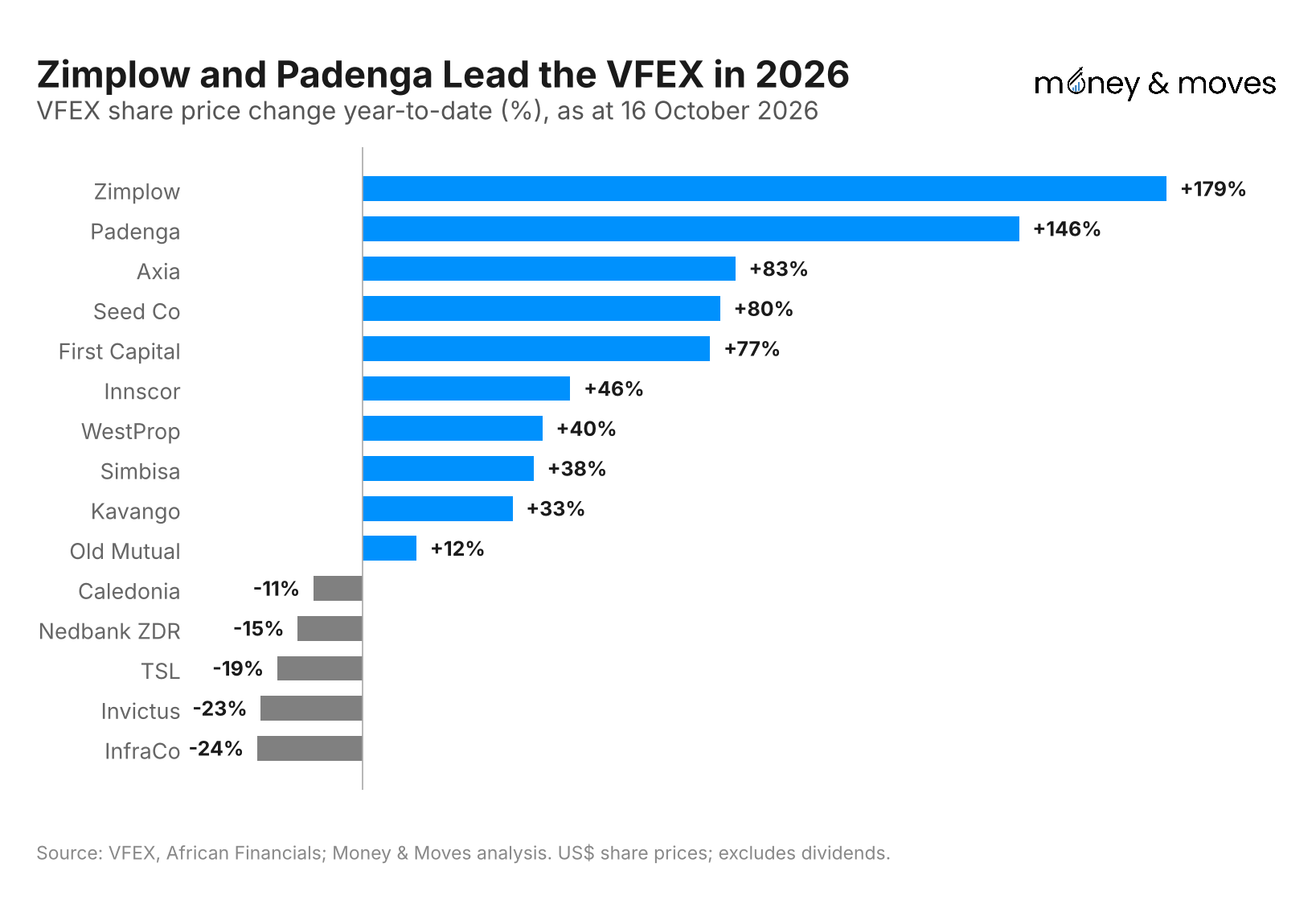
We have seen hints of this. The VFEX All Share Index was up roughly 67% in USD in the year to 16 October 2026, one of Africa's best dollar returns.
We have also seen solid capital raises. Pfuma REIT raised $25 million, fully subscribed, before listing in February 2026. Most of that likely came from institutions, with some retail investors, but it was still a strong capital raise.
This does not mean the VFEX has arrived. Liquidity is still a big problem. In September, the total value of shares traded on the VFEX was $26 million, or roughly $1.2 million a day. On the Egyptian Exchange (EGX), average daily trading value approaches $191 million.
In other words, while the EGX is about 20 times bigger than the VFEX by market cap, it is about 150 times bigger in trading value.
However, even with that, Takura still sees the VFEX as a good option.
Takura is selling $15 million of its existing shares, and if the offer is oversubscribed (more demand than supply), it can sell up to $9.8 million more.
How well Takura does from the exit is hard to know for sure. What we do know is that when Takura took over Cairns in 2015, it injected around $14 million. As reported at the time:
“Takura Capital will invest $7 million into the business on signing of the agreement and the other $7 million will be paid to the scheme participants,” said Saruchera.
If Takura’s total investment was around $14 million, I think they may have come out all right if they realise the $63 million valuation they have given the company.
However, without more data, we can’t really know.
Whatever the case, the best path for Takura now was an IPO, a small vote of confidence in a market that has been struggling with delistings.
The Final Test
That said, a prospectus is not the final result. When GetBucks, which was also PE-backed, had its IPO in 2016, only 2.29% of the shares on offer were bought. To be fair, the timing was also challenging then, whereas there is a bit more optimism about the economy now.
So let’s see what happens next, but I very much doubt a GetBucks situation.
Where’s the Money? What’s the Move?
For a long time, listing was not an attractive option, but I think that is changing. There is probably a lot more idle USD than before, with not enough quality assets. After all, it’s not sustainable to continue investing in property.
If you have a good business and want liquidity or cheaper capital, this may not be a bad time to consider listing.
Whether Amalgamated Brands itself is an attractive opportunity is still something we need to study, and it needs a separate, dedicated discussion.
Private equity sellers are known to be good at preparing companies for sale or an IPO, so you need to dive deep to identify the risks.
A few things already jump out. At the IPO price, the company has a P/E ratio of 14.6x based on FY2025 profit, but 8.7x based on the FY2026 forecast. Closing that gap requires profit to grow about 70% in a single year.
How much you believe in profit growth, and how sustainable it is, could significantly shape how you view the business.
Also, one has to look at benchmarks with other listed peers.
For now, it’s worth watching what happens on the VFEX. More listings could come, which would be welcome and hopefully help boost trading volume.
P.S. I am working with publicly available information, so I could be wrong or missing something. Thanks for reading!