



Imagine a made-up world where you are a financial advisor hired to set the bride price for traditional weddings. In this world, the bride price is set only on looks.
The bride’s uncle represents the family. He tells you how beautiful and stunning the bride is, then asks you to set the price.
You do your research and decide $5,000 is the right number. But you don’t want to give a number that may be much lower than expected. It could offend the family, because you would essentially be saying their daughter is not as beautiful as they think. So you give a range of $4,000 to $8,000. Both ends are defensible.
The uncle takes the range to the father. The father asks: “With that range, how much should the bride price be for my beautiful daughter?”
The uncle knows that if he says a number at the low end, it will look like he is saying she is not that beautiful. So he plays it safe and says $6,500, just above the middle of the range. But he adds a disclaimer: “It’s still up to you to decide. How beautiful is your daughter?”
The father concludes: “My beautiful daughter can’t just be in the middle. Surely she should be at the high end.” He settles on $7,500.
That is a 50% premium on the price you first calculated.
Nobody in this story is dishonest. The process itself tends to push the price up. This example is only an analogy and not necessarily about this IPO. But it shows how pricing can drift within a genuine range.
When you have a good looking company ready to IPO, nobody responsible for setting the price wants to undervalue it.
So how beautiful is Amalgamated Brands? Let’s unpack!
A good-looking company
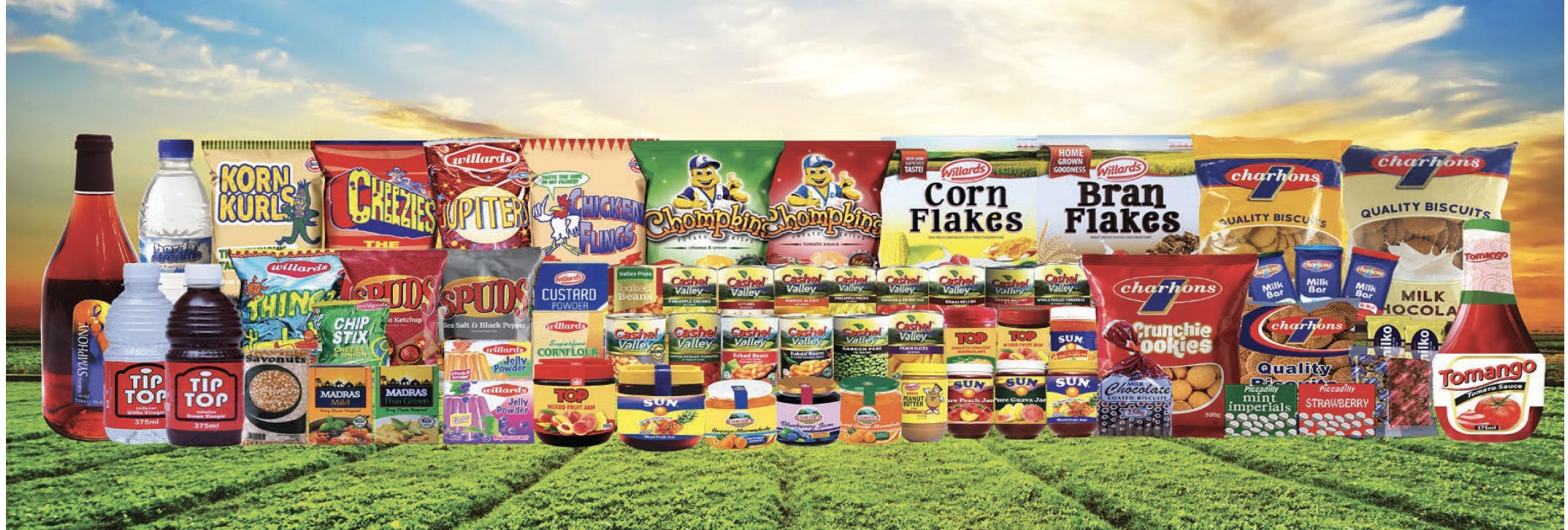
First, it is worth noting that Amalgamated Brands is a “good-looking” company, mainly because of its brands.
We often underestimate the value of strong local brands. One of the risks AB acknowledges in its Prospectus is competition from imported brands such as Lays, Simba and Doritos.
The most significant recent development it flags is Varun Beverages, the PepsiCo bottler, moving into chips and snacks, first through imports and now through local production.
AB’s defence is its “multi-decade brand heritage”. In other words, its brands go way back.

This should not be underestimated.
In a country in which every concrete fence is called a Durawall, all drinks are called Cokes, and all dishwashing liquid is called Sunlight, brands entrenched in Zimbabweans’ minds have incredible value.
We discussed this in the Delta vs Varun story too. Delta in the past, lost market share to Pepsi brands because of steep discounts. Once pricing was in the same range, people started switching back to Coca-Cola brands.
Another example is Dairibord, which also has many heritage brands with decades of history. Its latest numbers show a strong uptick in sales, with revenue up 28% and volumes up 26% in the six months to June 2026.
That suggests local brands remain in demand, and supply may have been the limiting factor.
AB shows the same pattern. Sales were up 25.1% to $73.2 million for the 9 months to September 2026, compared with the previous year. That is impressive growth.
For reference, Innscor’s revenue for the year to June 2026 was up 14%, although that is off a base of more than $1 billion. It again suggests that demand is there and supply may be the bottleneck.
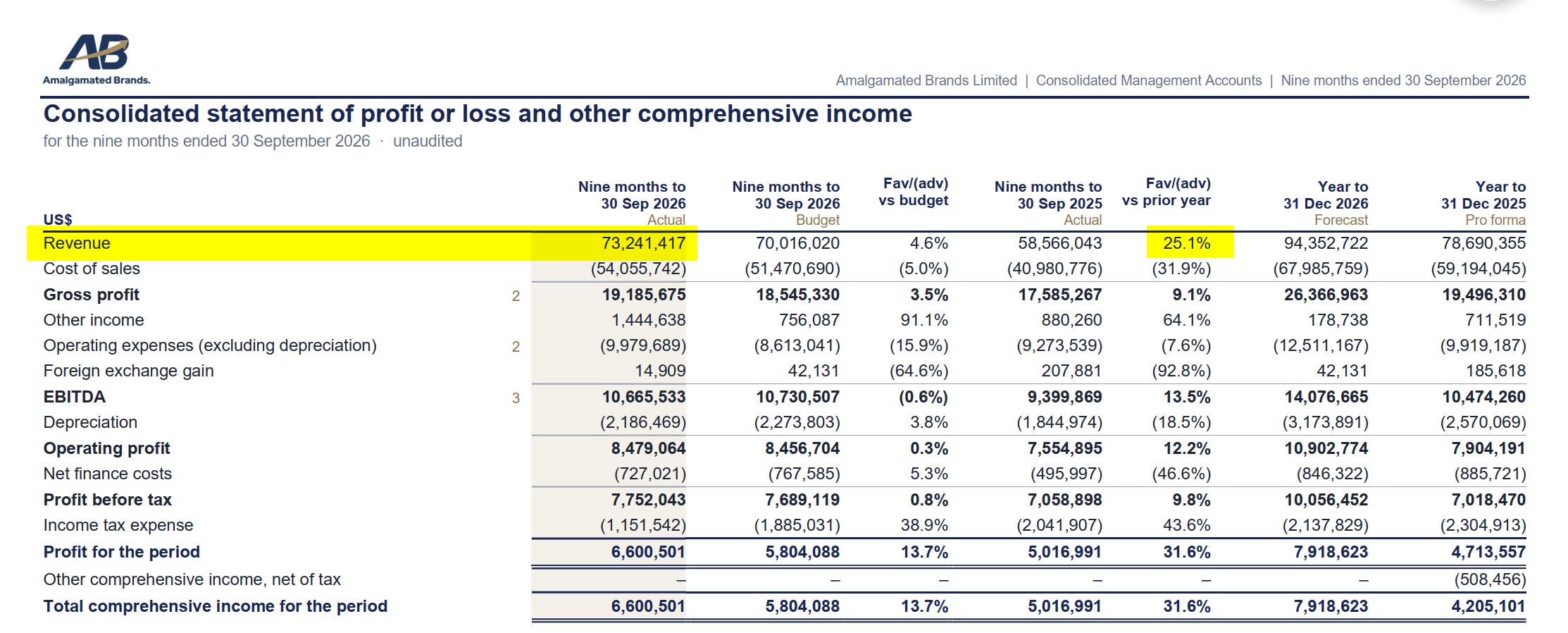
So the numbers show good growth and decent profitability. The EBITDA margin was 14.6% for the nine months, although it was boosted by higher-than-normal other income.
Given that the company could have been liquidated, Takura Capital has done well to get the business to this point.
You could say Amalgamated Brands is a good-looking company. But just how good-looking is the question.
How good-looking is Amalgamated Brands? Benchmarking the valuation
One way companies are valued is essentially like a beauty contest.
You look at how one company looks and the valuation it has been given. Then you do the same for yours.
One common comparison is the P/E ratio, how much you pay for each dollar of annual profit. If a company makes $10 in profit per share and trades at $80 per share, the P/E ratio is 8x. Generally, the higher the PE, the more “expensive” the company is.
For this contest, I looked at companies similar to Amalgamated Brands (AB): Axia, Innscor, and Tiger Brands from South Africa, as well as Delta, which is a broad benchmark for the Stock Exchange overall.
Less reliance should be placed on Tiger Brands because it is not local, but it helps for context.
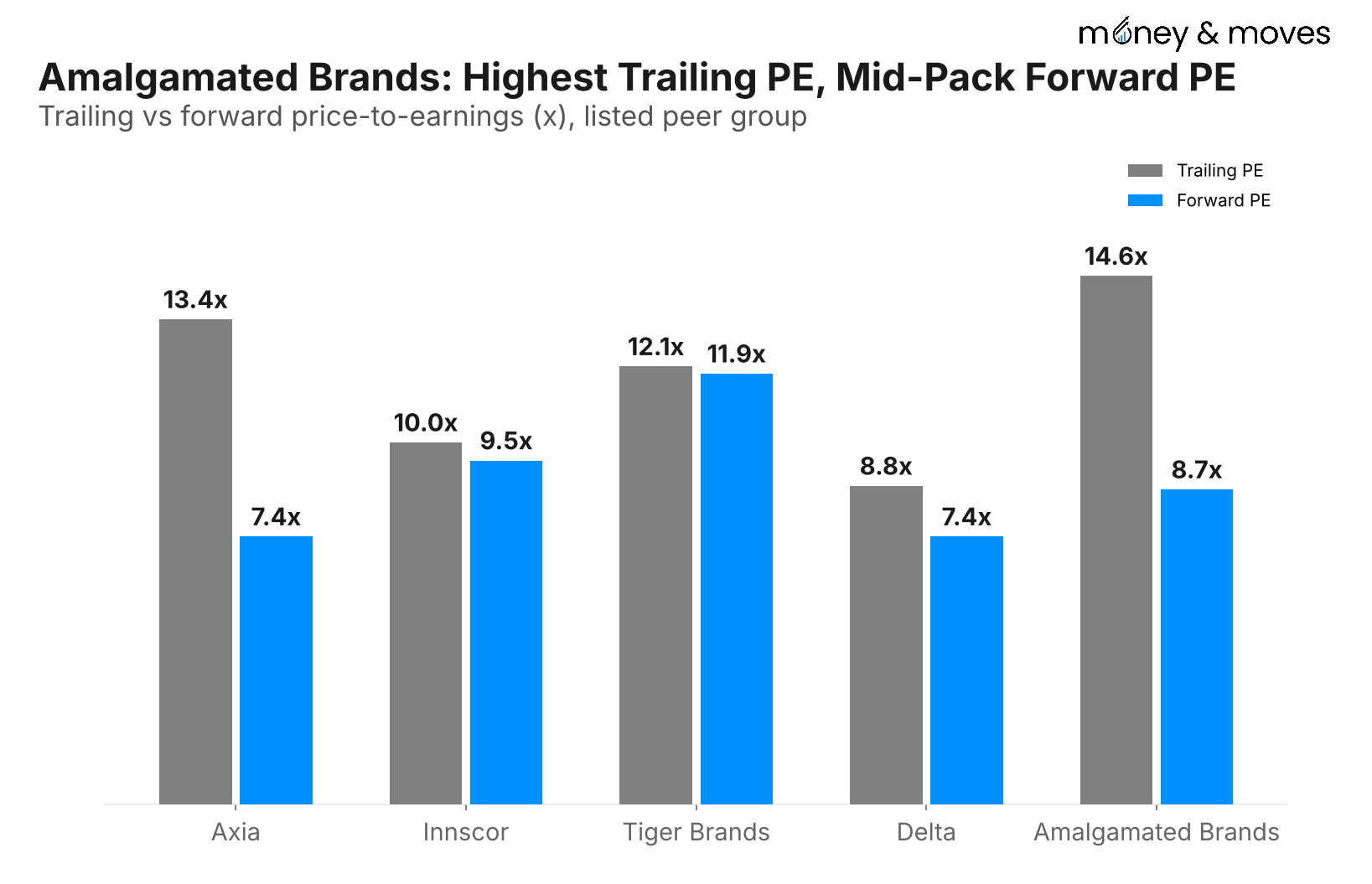
From the chart, AB has the highest trailing PE at 14.6x using the FY2025 numbers. However, if you calculate the trailing PE through September 2026, my calculations show it comes closer to 11x.
On the forward PE, AB is at 8.7x. That compares the share price with forecast profit. It is above Axia and Delta at 7.4x, and below Innscor at 9.5x.
Forward PEs depend on forecasts, so they are not certain. For AB, the 9-month results suggest it will be close to its forecast, but $1.4 million in other income boosted the results, which is not operational.
So if this were a beauty contest, AB may not be the most attractive, as its PE is higher than, or as high as, already-listed blue-chip peers, but it also doesn't look completely out of place.
How beautiful is AB? The DCF view
The other approach is a DCF valuation.
Here you don’t compare the company with any other. You look at the business on its own by forecasting the cash it will generate and discount it back at the cost of capital.
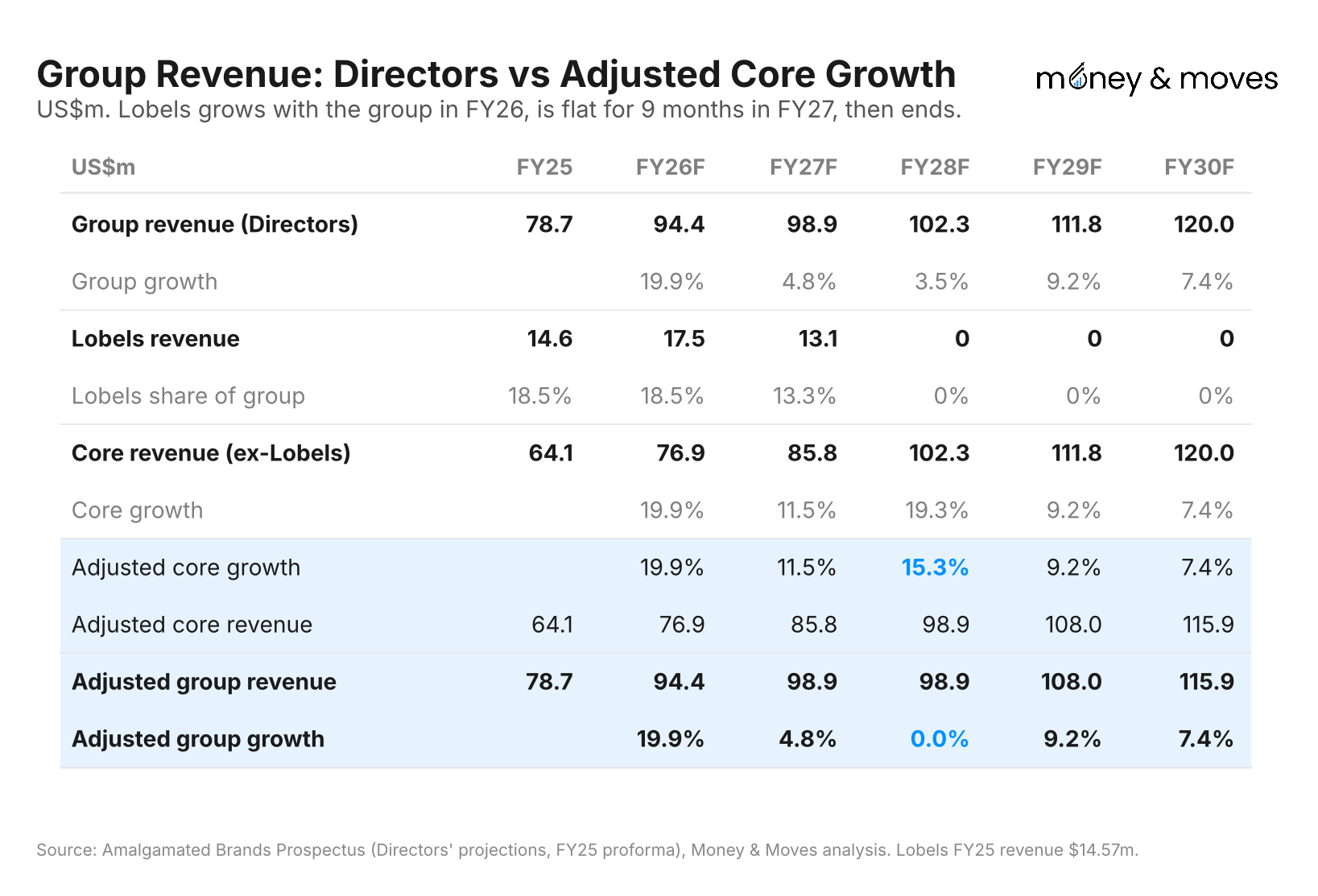
For this, we used management’s forecasts as shown in the prospectus but made two key adjustments. On revenue, the biggest area of judgment is the Lobels contract.
The Lobels contract
Lobels is no longer part of the listed group, but AB generated about $14.6 million of revenue from Lobels in 2025, mostly by providing logistics services.
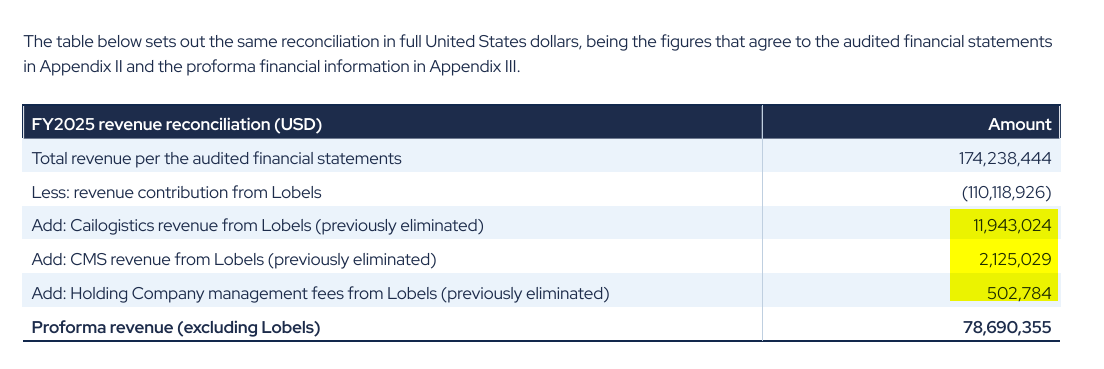
The contract expires in September 2027, and there is a risk it will not be renewed. Management’s forecasts do not include that revenue after the contract ends. Instead, they assume the rest of the core business will grow to use up the freed capacity.
To test that, we assumed Lobels revenue grows in line with the rest of the business in 2026 and stays flat in 2027, for the nine months until the contract ends.
On that basis, the core business needs to grow revenue by about 19.3% in FY28 to meet the forecast, after growing 11.5% in FY27. Even with the new capex and reallocated capacity, that looks aggressive.
So I assumed 15.3% core growth in FY28. That is still impressive. But it means group revenue is flat that year, which makes sense given the size of the loss.
EBIT margin
The other major change is EBIT, which is operating profit after depreciation. The forecasts show the EBIT margin rising from 11.6% in FY26 to 15.4% by FY30. I think there may be improvements, but it is hard to see such a sharp rise, for two reasons.
First, Varun is entering the snacks market and is known for very aggressive pricing to gain market share.
To illustrate the impact, Delta’s Soft Drinks business had an operating margin of 17% in 2015, before Varun entered the market. By 2024, it was 11%.
Secondly, EBIT margins for SA based peers like Tiger Brands are much lower than 15.4%. In FY 2025 Tiger Brands operating margin was 11.1%, and even its best segment, which is the closest match to AB's snacks and beverages, makes 13.7%.
So I have used a 13.0% EBIT margin from FY27, which I think is still pretty strong.
Discount rate and long-term growth
I have used a discount rate (WACC) of 16%. This reflects the return investors need given the business's risk.
For the terminal value, I used a long-term growth rate of 4.7%, the maximum recommended under Aswath Damodaran’s approach (long-term growth should not exceed the risk-free rate).
The result
So how good-looking does AB look on the DCF?
On these assumptions, the DCF values AB at about 28c per share. This is after deducting net debt of $5.1 million as of 30 June 2026. Net debt was only $1.8 million at December 2025. Debt appears to have risen in part because the company paid a $3.25 million dividend to Takura, which would have put more demands on cash flow.
The offer price of 35c is about 24% above that value.
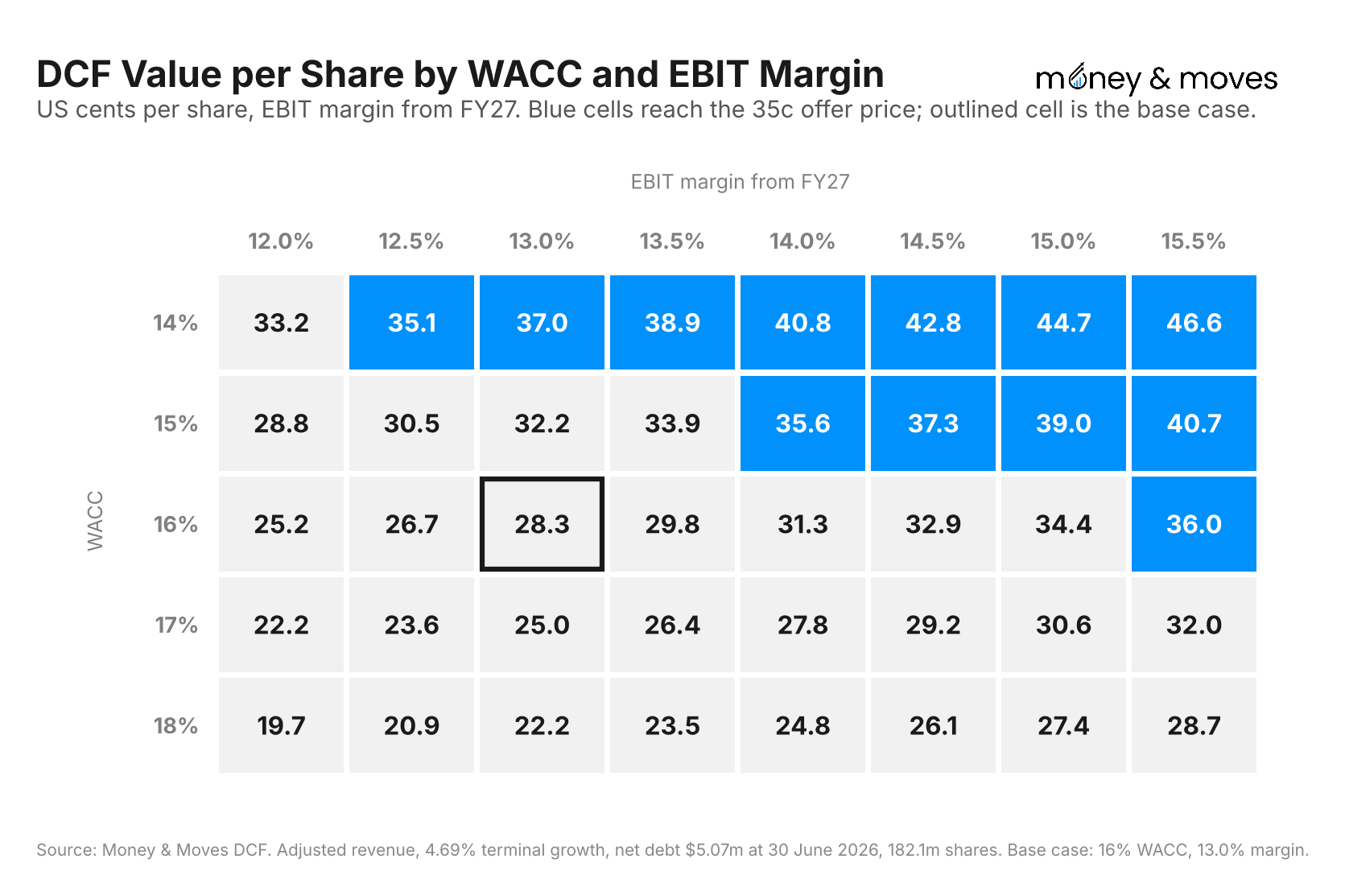
The chart shows how much the answer depends on the assumptions.
To reach 35c, you need either a WACC of about 14.4% or, at a 16% WACC, an EBIT margin of about 15.2%, which is close to the FY30 margin forecast in the IPO prospectus.
Using the Directors’ assumptions at the same 16% WACC, the DCF gives about 36c, so 35c is consistent with their forecast.
The gap to the 28c comes from the two adjustments shown earlier: FY28 revenue and the 13% EBIT margin.
So the real question is what you believe about those adjustments and also the WACC. In my view, the data suggest the price leans toward the aggressive, or high, side.
There could be good reasons for that, or additional information that could change the picture, but for now that is how it looks.
The other issue: supply and demand
As we discussed with the Dangote IPO, the main financial reason to buy a stock at IPO is that you believe the price will be higher afterwards.
We also discussed that valuations, while important, don’t always matter as much with IPOs as what ultimately drives the share price is demand and supply.
With Dangote, hype, marketing, and the Dangote Premium could easily drive the price much higher than the valuation would warrant.
In this case, a few factors could slow any increases in the stock price.
As currently structured, Takura will own about 69% of the shares after the offer, or 136 million shares. That falls to a floor of 55% if the capped oversubscription is fully taken up.
Most importantly, the Prospectus says no shareholder has a lock-up period.
A lock-up period is a designated period, typically 90 to 180 days after the IPO, during which major shareholders such as company insiders and early investors are prohibited from selling their shares.
The idea is to stop the market from being flooded with too many shares too quickly, which could push the price down. Investopedia has a good explainer if you want more detail.
IPOs without lock-ups are not common, but this one has none.
In addition, the seller, Takura Capital, plans to sell down its stake where it can, as you would expect from a private equity investor.
If Takura is willing to sell at 35c, it will be willing even more if the price rises. So there is a ready supply of 136 million shares set against thin trading volumes on the VFEX and few buyers.
To be fair, Takura cannot sell 136 million shares at once or in large blocks that disrupt the market. The Prospectus says it plans to reduce its stake through “orderly disposals”, but it places no restrictions on when shareholders can sell.
Based on simple demand and supply, that still puts pressure on the share price. It is hard for it to rise meaningfully, especially since the IPO pricing does not seem to be at a big discount.
Where’s the Money? What’s the Move?
Ultimately, the question is like asking how beautiful your daughter is. It depends on who you are and how you see Amalgamated Brands.
AB looks like a good-looking company. It has strong brands, good growth and decent margins. The issue here is less about the business but more about the pricing.
One gets the sense that, within the valuation range, the price is slightly skewed to the high side. This makes it a hard sell for value-focused investors who prefer a margin of safety.
That said, beauty is in the eye of the beholder, and investors are different.
If you have deep industry knowledge and really like AB's look, it could be worth considering. Also, if you have significant exposure to peer-group stocks and want to diversify, this could be an option.
You would need strong convictions and a solid exit plan, as selling at an attractive price may take patience and good timing, given the thin trading volume and large supply of sellers.
It’s also not the most obvious dividend play. With the planned capex funded from operations, I’m not sure how much free cash flow will be available for dividends.
If you like the business but not the price right now, it may be worth waiting and seeing what happens once it lists.
So how “beautiful” is Amalgamated Brands to you?
I may update this piece if new information comes to light, so stay subscribed and look out for other analysis.
If this sharpened your thinking, forward it to someone facing a similar decision. The right analysis at the right time can be worth a lot.
P.S. This is for educational purposes and not financial advice. Do your own research. I am working with publicly available information, so I could be wrong or missing something. Thanks for reading!
Brilliant writeup