


Zimbabwe’s mergers and acquisitions market has been busy in 2026, and one name keeps showing up: Mega Market.
Mega Market is best known as a distributor of rice, flour, and other household staples, run out of Mutare by 40-year-old entrepreneur Shiraan Ahmed.
We first covered this company in “Truworths Falls: The Winners and Losers,” where it showed up holding stakes in Turnall, Truworths, Meikles, Art, Mashonaland Holdings, and more.
Right now, the company is planning to buy Lobels, one of Zimbabwe’s biggest bakeries. At the same time, it’s negotiating to sell its stake in Dairibord, the country’s biggest dairy processor. And it’s sitting on a stake in Tanganda that could be bought out within months.
Mega Market is making “Mega Moves”.
Let’s unpack!
The Numbers
Increased M&A activity is another indicator that people are more bullish on the economy.
Zimbabwe’s Competition and Tariff Commission handled 30 merger cases in 2025, deciding on 26 of them.
That was an 86% increase in deal activity compared to the previous year. The regulator expects the momentum to continue into 2026.
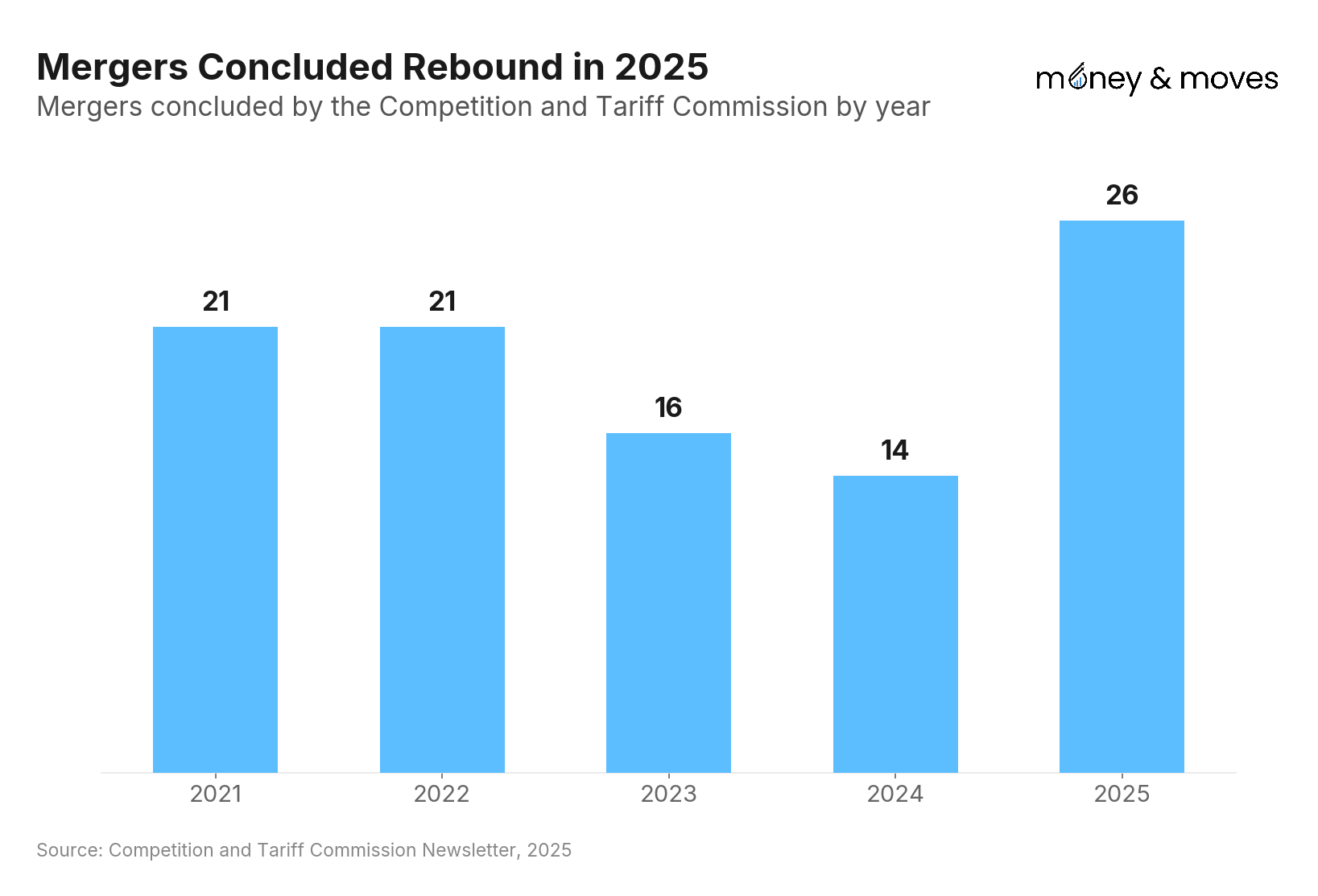
However, 30 deals a year is still a small number. In South Africa, that number was 287, about 10 times more. This also means Mega Market is a key player in potentially 10% of all major M&A deals, and they could still be involved in more.
Note: The Competition and Tariff Commission (CTC) in Zimbabwe only reviews mergers and acquisitions where the combined annual turnover in Zimbabwe or the combined assets in Zimbabwe reach or exceed USD 1.2 million.
The most topical deal concerns Dairibord, the dairy and beverage maker. Mega Market, together with Equivest Asset Management and Mutare Mart & Exchange, has entered talks to sell a combined stake of more than 51% in Dairibord Holdings.
Varun Beverages is reportedly the player who initiated the deal, but other reports also say that Delta Corporation has entered into bidding.
Why Varun Could Want Dairibord
We’ve covered Varun a bit recently and highlighted that Varun’s margins and growth have recently come under pressure from the sugar tax and stiffer competition from Delta.
The graph below paints that picture. Last year, both revenue and margins fell.
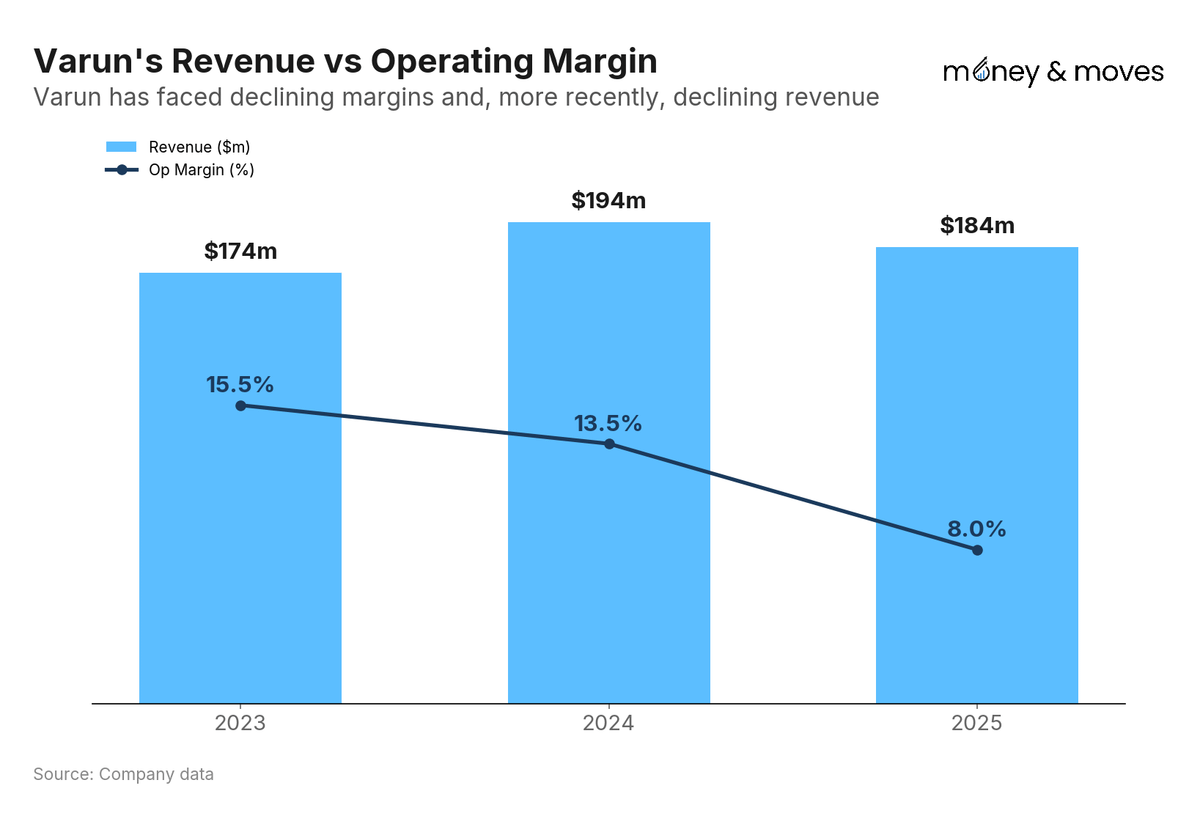
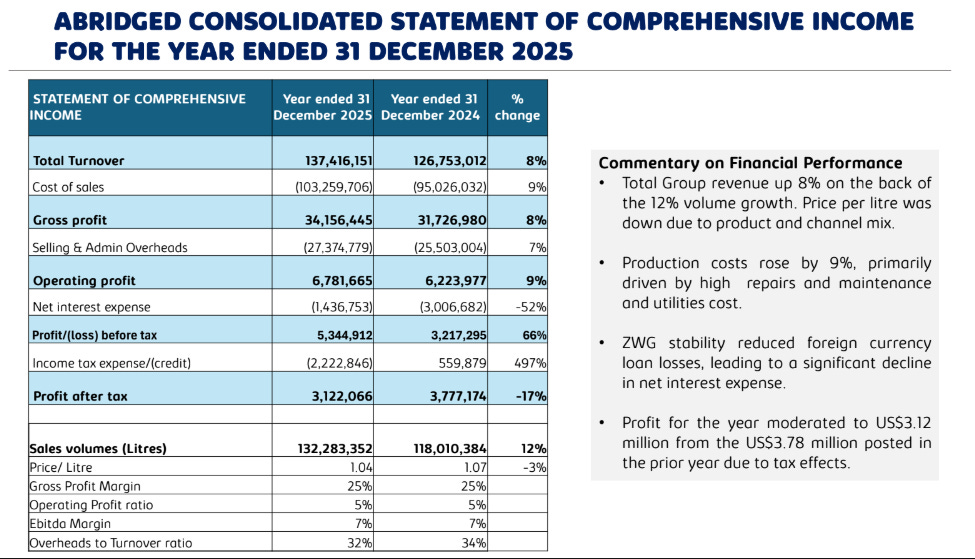
With the core soft drinks business slowing, buying a business with scale and strong brands becomes an attractive way to offset the slowdown. Dairibord fits that logic well. It has strong brands like Cascade and Pfuko Maheu, and meaningful scale, with $137 million in revenue in 2025.
The move would also be consistent with Varun’s recent deal-making playbook. In South Africa, the group has bought The Beverage Company (BevCo) for about $158.3 million in 2024, Twizza for $125 million in 2026, and notably Crickley Dairy for $14.3 million, also in 2026.
Why Mega Market Might Want Out
On the other side of the table, one can see why Mega Market might want to sell.
Dairibord has potential. It holds a dominant 37% share of the milk market and strong beverage brands. But the numbers haven’t matched the potential. Dairibord’s operating margin was 5% in 2025 and 2024, roughly half of Varun’s own 10.5% over the same period.
Net profit margins are less than 3%, which is very low for a manufacturing and exporting company. Innscor is at about 9%, and Delta is much higher.
As a minority shareholder, Mega Market must ask whether it can unlock Dairibord’s full potential without complete control and whether this investment is the best way to allocate its capital.
Without clear conviction on both, the ability to exit your position in one go is attractive, since selling a large minority stake on the open market is very difficult even if you are willing to take a discount.
In this case, Mega Market would exit at a premium over the pre-announcement price.
Redeploying the Capital
Whatever happens with Dairibord, reports suggest Mega Market is going to buy 100% of Lobels, a business that arguably fits more naturally with its existing operations.
In some ways, Mega Market is evolving into an Innscor-type entity that touches all major consumer staples. It is also commendable that this is happening from a base outside of Harare, which often dominates the local market.
This transaction also means another successful exit for private equity firm Takura Capital, which currently owns Lobels.
Lobels was rescued by Takura Capital back in 2015, when Takura took on about $18 million of the bakery’s debt to keep it alive. After holding the asset for over 10 years, Takura will be able to exit their position.
This is not to be underestimated.
Exits are not easy in African private equity, and are much harder in the Zimbabwean context. In a market where the regulator handles about 30 sizable deals a year, the buyer pool for any single business is small. Any exit is a big win in this market.
This also highlights that with Private Equity in Zimbabwe, when you buy a business, you need to be prepared to hold on for a long time.
The last “Mega Move” that is still ongoing is the potential acquisition of Tanganda by Rutanhi Beverages, Innscor’s beverage arm. Rutanhi underwrote an $8 million rights offer and emerged as Tanganda’s largest shareholder
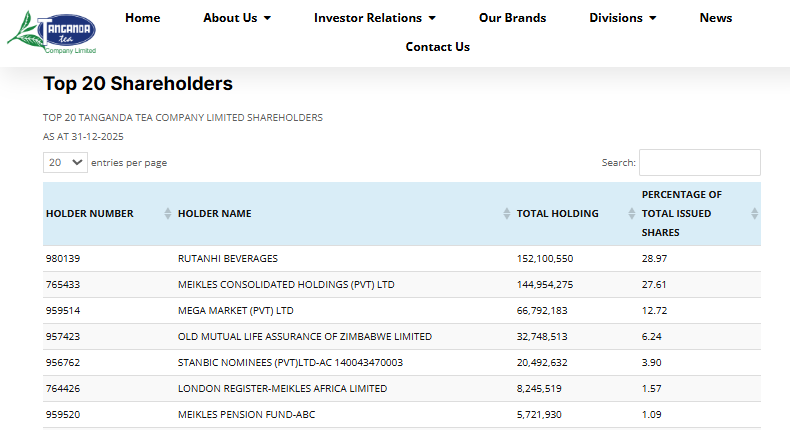
Rutanhi has indicated it intends to make an offer to minority shareholders at some point to buy them out, which would mean Mega Market could raise another $4m-$7m (depending on the share price and valuation).
It will be interesting to see what other moves Mega Market could make.
There are already a few I see that could make a lot of sense.
Where’s the Money? What’s the Move?
I don’t think this is the last M&A move we see out of Zimbabwe this year. This creates a lot of opportunity.
If you’re an investor, companies that look like realistic acquisition targets, strong brands, lots of potential, and fragmented shareholder bases could be worth watching.
If you sit on the board of a company with a meaningful balance sheet and M&A hasn’t come up in a while, that’s worth revisiting. M&A has destroyed plenty of value over the years. But it’s hard to find a genuinely successful business that hasn’t also used it well, at some point, to grow faster than it could have alone.
If your board or leadership team is planning its next strategy session and needs an outside perspective on your growth options, reply to this email or message me here.
P.S. I am working with publicly available information, so I could be wrong or missing something. Thanks for reading!
Thanks Tina, provoking read as always , I have something to long to comment that got to me after reading this piece.
Mega Market isn’t just driving fast… they’re flooring it straight to the Innscor buffet like they haven’t eaten in 3 quarters.
Competing was cute. But buying Lobels? That’s walking into Innscor’s house and eating their lunch. This isn’t market competition.
They watched. They learned. And now they’re buying Lobels like, “cool bread, cool snacks, cool empire… I’ll take one.”
Because if Innscor turned flour and chicken into an ATM, Mega just decided: “we know flour, we know commodities… now we want an ATM too.” Right.
And hold up — I have a little conspiracy.
Could they go for _Eat n’ Lick_ next?
The company looks like it’s running on fumes lately, but the brand still slaps and that shawarma is elite. They were also originally born out of Mutare, meaning proximity and home, if my high school memory serves. Built on vibes, and people still remember it.
I’d argue to Mega Market, Eat n’ Lick is the definition of “brand value + struggling execution = bargain bin takeover.”
Because here’s the thing: if Innscor turned flour and chicken into an ATM, Mega just decided they want the whole bank.