


Finance Minister Mthuli Ncube presented the 2027 National Budget last week, and with the Budget Statement running to 284 pages, there’s a lot to unpack.
The official theme is “Accelerating Economic Transformation and Building Resilience to Climate and Global Shocks.”
However, as always, most business leaders go straight to the tax measures, and there, one message stands out.
Formalise or die.
Let’s unpack.
Mining Growth has been exceptional
To start off, the budget highlighted what we already know: the economy had a good run over the last 18 months.
What also became more apparent was just how important the mining sector has been. The chart below shows how fast the sector has grown, and how much that growth is expected to slow.
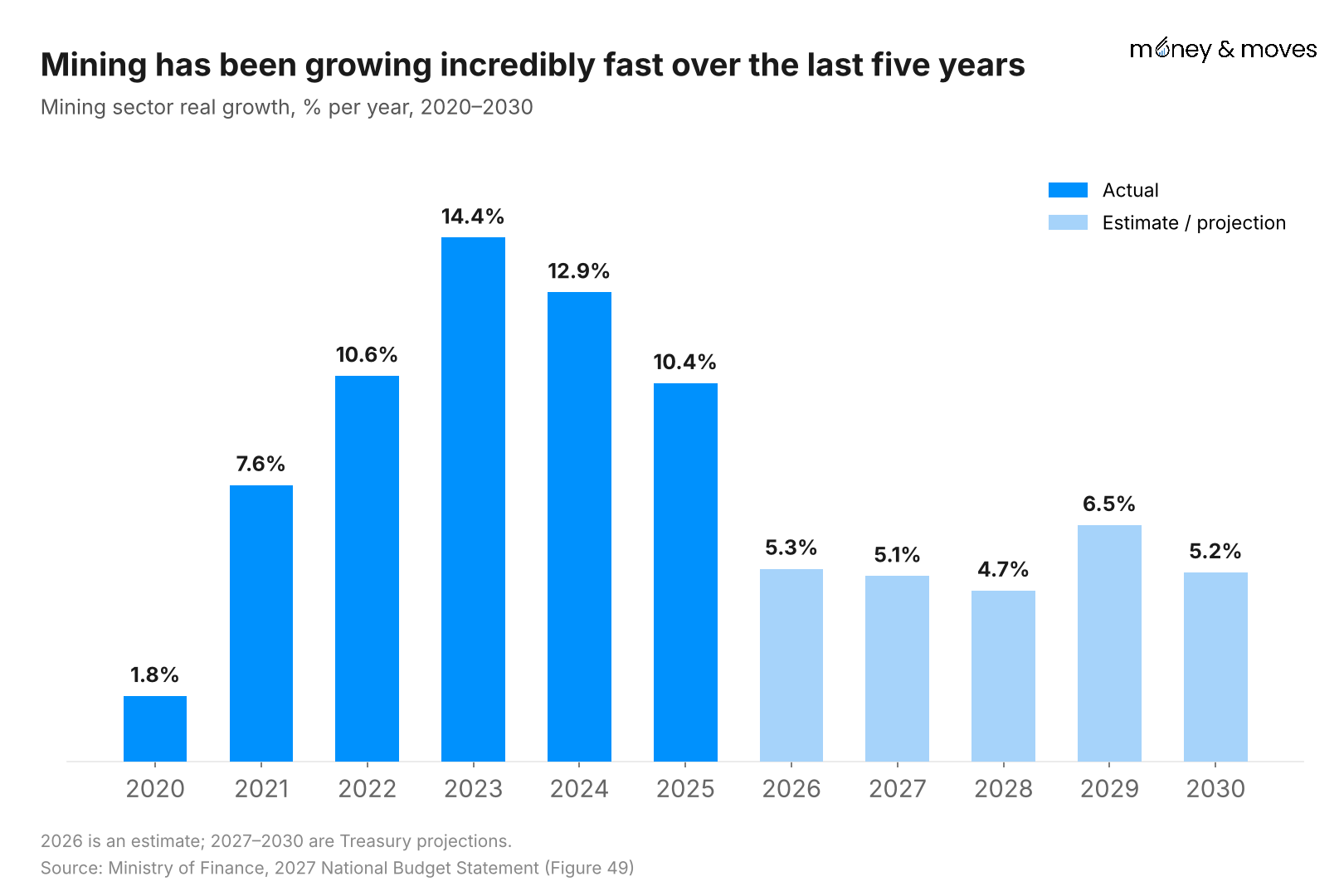
This growth in mining has been a massive boost for the economy, and it has shown up in tax collections too.
Between January and September 2026, mining was the biggest sectoral taxpayer: it paid 16.8% of all corporate income tax and 25.3% of customs duty, plus ZiG10.7 billion in mineral royalties.
Put together, that is an estimated 11% of all revenue collected (by my calculations).
A lot of that has been driven by gold, which we wrote about earlier this month.
One thing worth noting is that the budget assumes a gold price of US$4,250 an ounce for 2027, in line with the World Bank’s forecast.
As of 25 November 2026, gold was trading at about US$3,530, already around US$720 below that. At that price, I estimate that gold export earnings would be over US$1 billion a year lower. (The chart's footnote already explains the method).
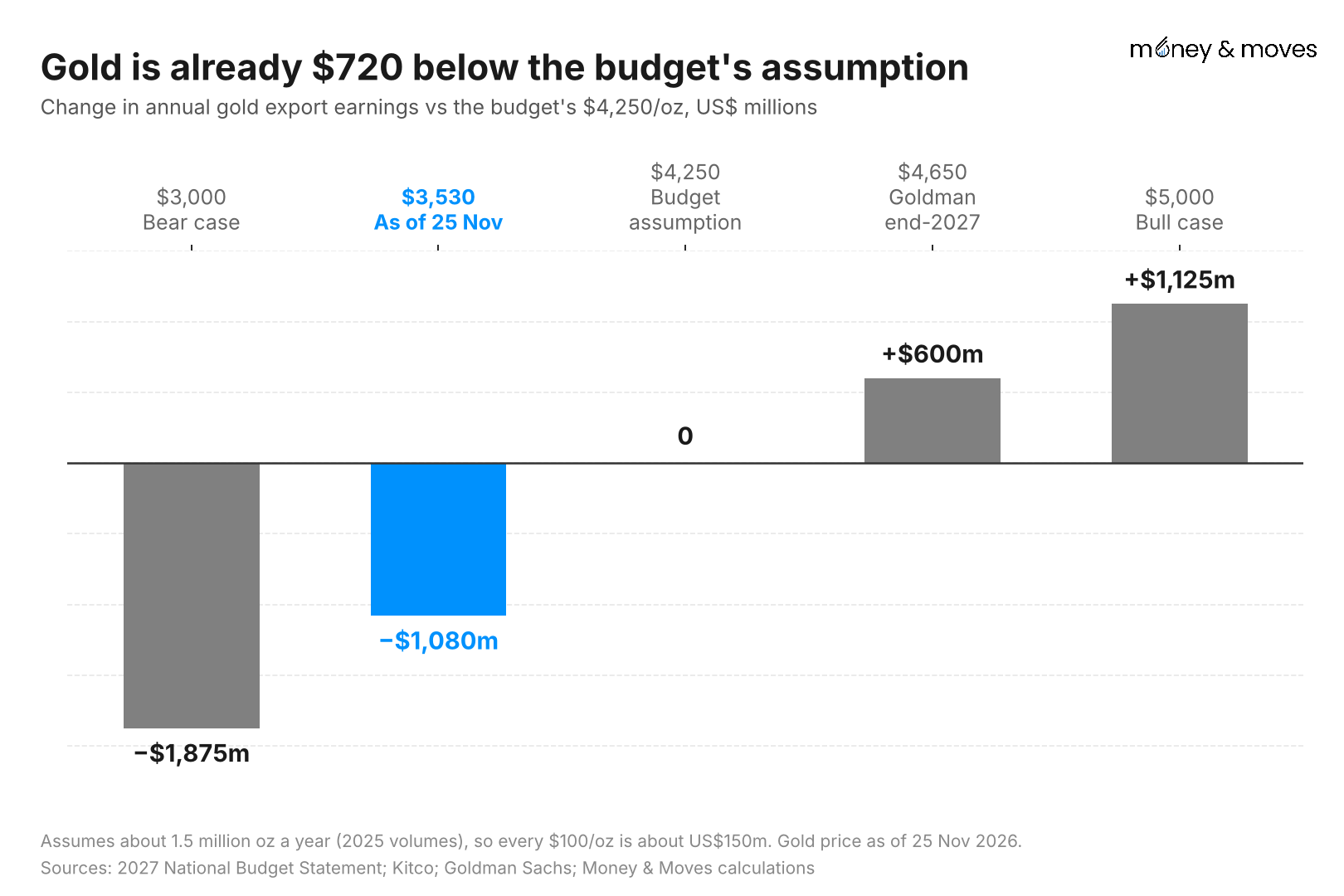
Part of that shortfall would show up directly as lost tax, but it would also mean less money in the economy.
If the price stays there or falls further, there could be a big revenue shortfall, and someone has to make it up.
That someone is usually you and your business.
So if gold has a rough year, the chances of more aggressive tax enforcement go up.
The hope is that, as long as Donald Trump is president, there will be enough volatility to stimulate safe-haven demand and central bank buying to support the price, even though US interest rates are now rising, which in principle is bad for gold.
Goldman Sachs still forecasts US$4,650 by the end of next year, but it’s worth noting that it has cut that forecast twice this month, from US$5,400 to US$4,800 and now to US$4,650.
However, perhaps the biggest theme of the budget is the push to formalise.
Formalise or die
There is a strange paradox here.
On KPIs such as the revenue-to-GDP ratio, Zimbabwe could, in theory, be said to be undertaxed. Yet it feels like the opposite.
This chart tells a lot of the story.
First, it shows that in the past Zimbabwe was not collecting enough revenue or tax, by quite a margin. It also shows that over the last few years the tax authorities have done a good job of collecting more revenue, something that was necessary.
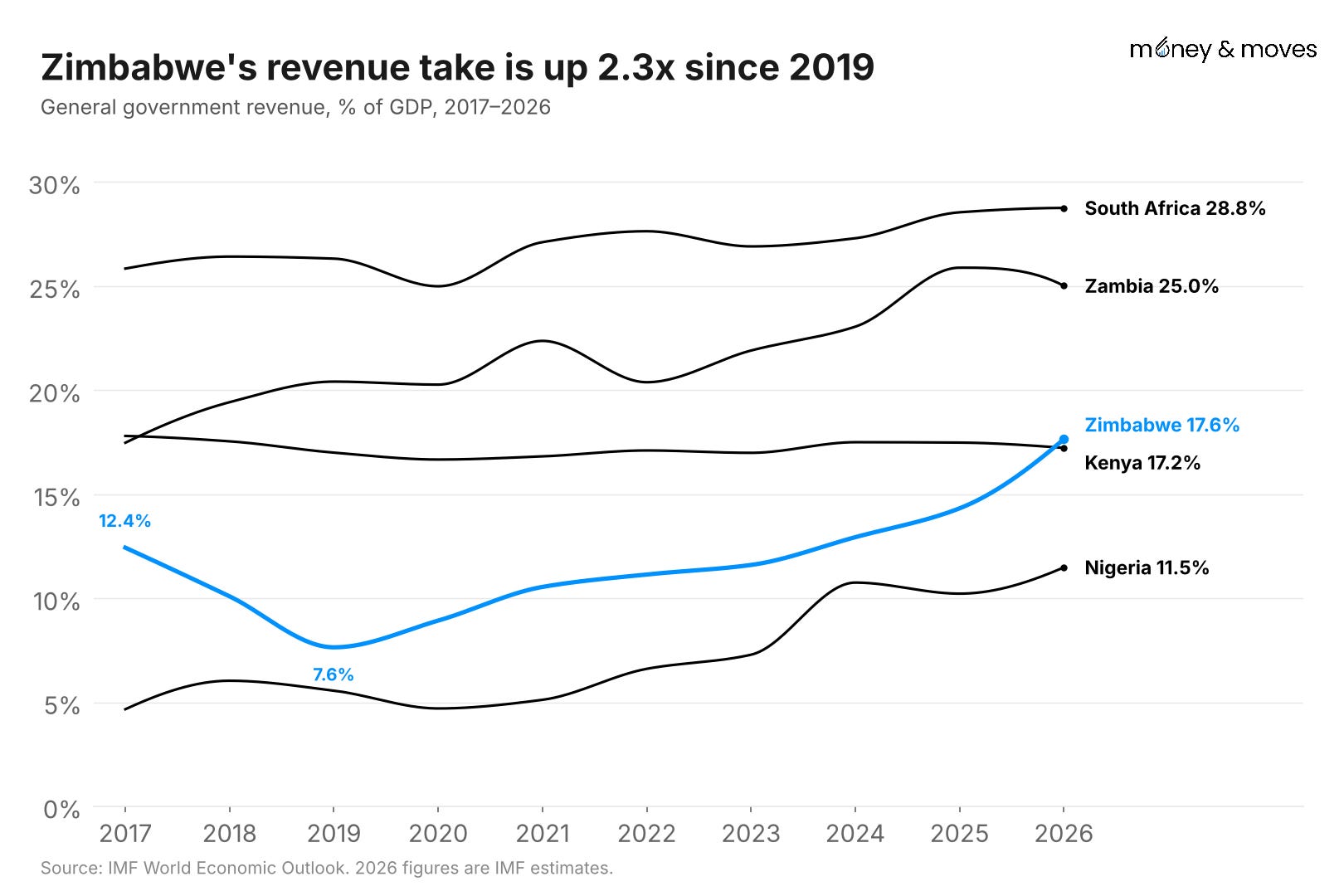
Since 2019, the revenue-to-GDP ratio has more than doubled, from 7.6% to 17.6%, the biggest improvement of the five countries.
Interestingly enough, even after that jump, Zimbabwe still looks technically undertaxed: its ratio is well below South Africa’s and Zambia’s, and only just ahead of Kenya’s.
So why does it feel like you are overtaxed?
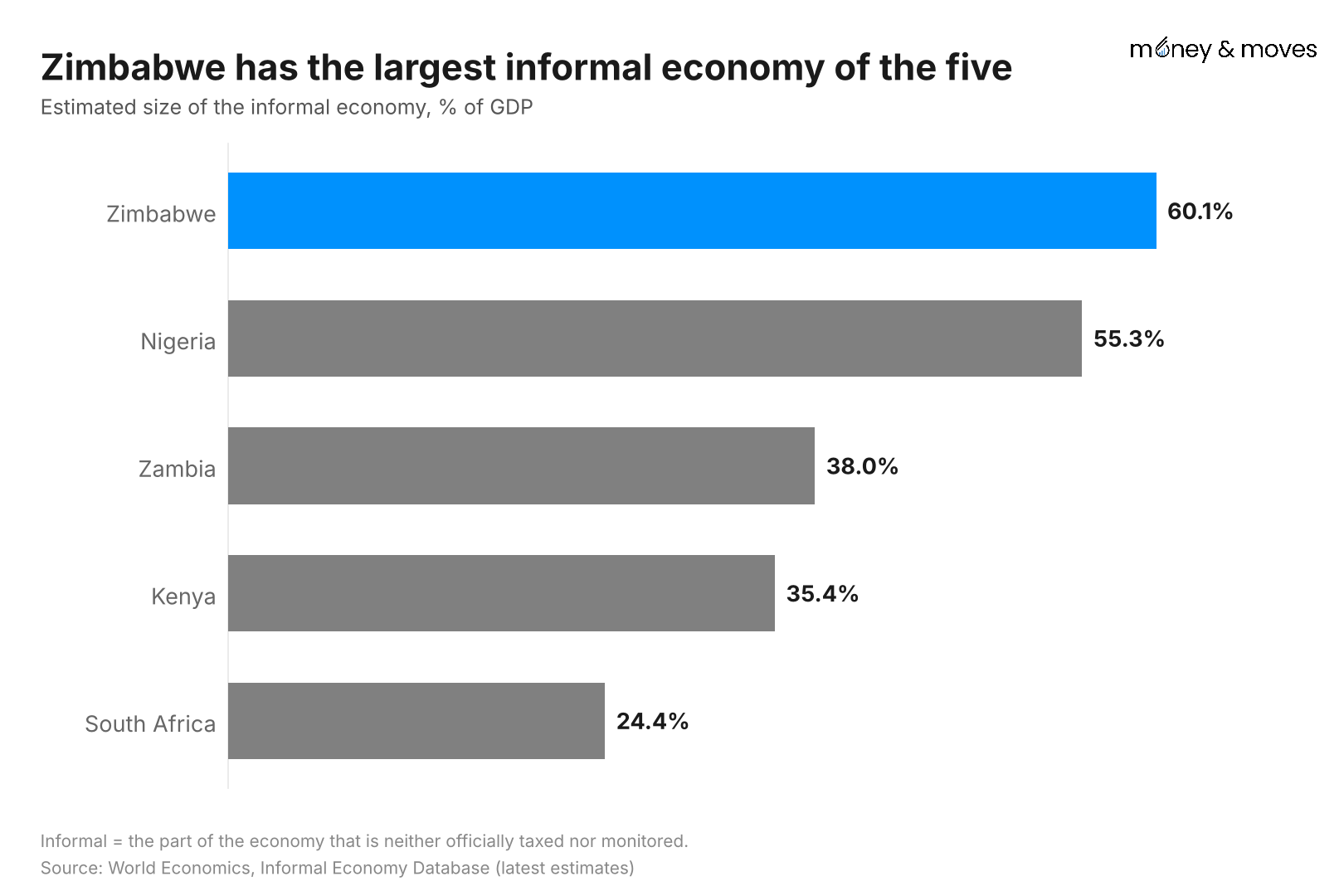
Well, the issue is how informal the economy is.
In the World Economics database, it is second only to Afghanistan worldwide at 60.1%. It’s important to note that the definition used for “informal” in that data set is “the part of any economy that is neither officially taxed nor monitored.” In other words, about 60% of the economy is paying minimal to no tax.
When we look at peer countries, as shown below, Zimbabwe is estimated to be even more informal than Nigeria.
Now let’s see how this impacts the tax burden.
With the data on informalisation and the revenue-to-GDP ratio, we can calculate an implied formal sector revenue-to-GDP ratio.
This estimates which country’s formal sector carries the heaviest load to generate revenues.
As you can see from the chart, Zimbabwe’s formal sector carries the heaviest revenue load of the five, at 44.2%.
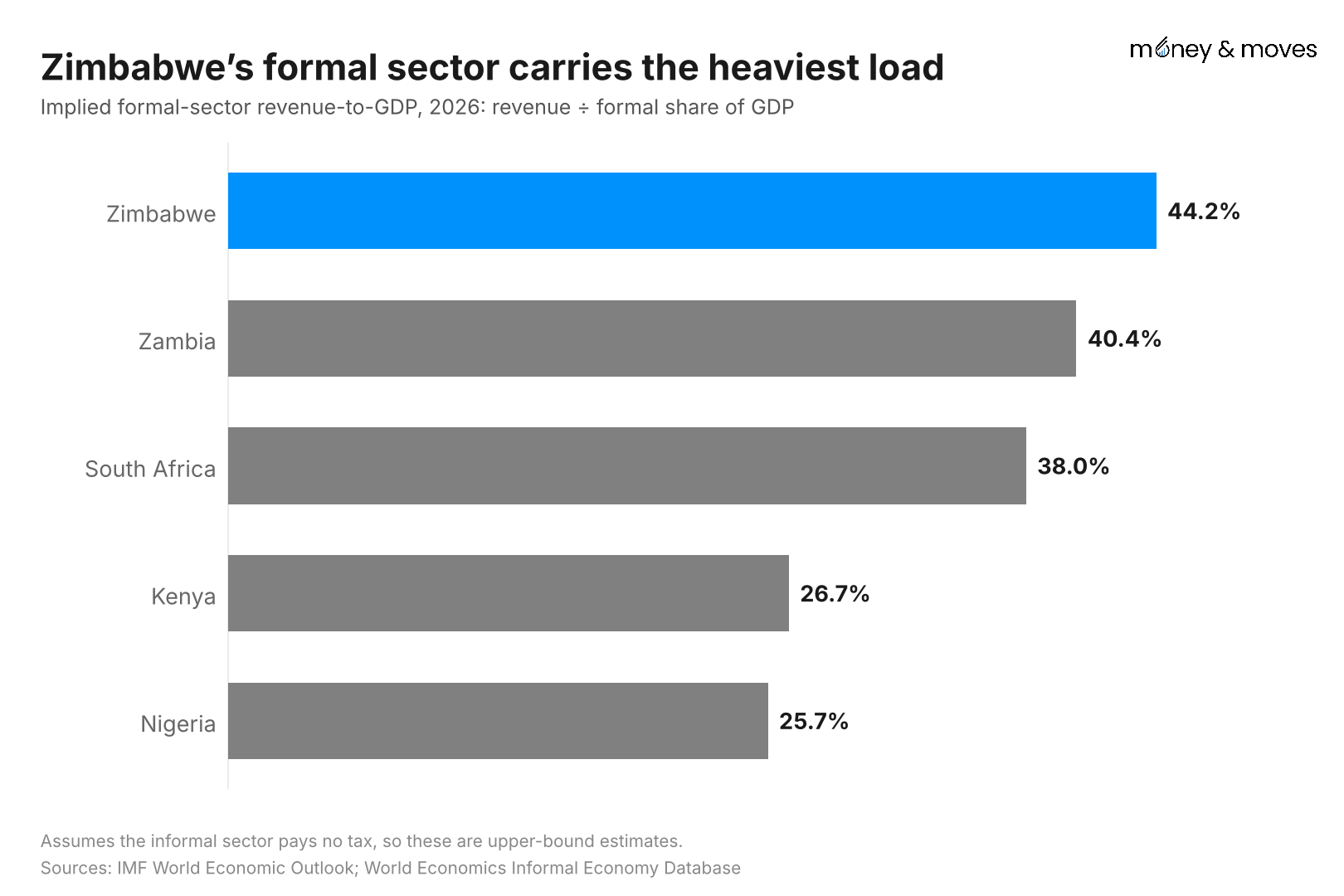
To understand the 44.2% calculation, let’s work through it.
Zimbabwe’s revenue-to-GDP ratio is 17.6%. So let’s assume GDP is 100, so 17.6 is collected.
However, that 17.6 does not come from the whole 100.
With 60.1% of the economy informal, only 39.9 of that 100 is formal, and that is the part actually paying. The formal sector is therefore carrying 17.6 ÷ 39.9 = 44.2% of its output in revenue.
In reality, informal traders do pay some tax, for example, through VAT built into some of the goods they buy. So 44.2% is an upper bound, not an exact figure. But even if the true number is lower, the point stands: a narrow formal base is carrying most of the load.
If revenue stayed at 17.6% of GDP but the economy became 50% formal, the same 17.6 would be spread over a formal base of 50, and the ratio would drop to about 35% (17.6 ÷ 50).
So this explains why the formal sector feels so heavily taxed.
The budget tries to fix that not so much by cutting taxes, although there have been some concessions, but more so by getting more people into the tax net.
Widening the tax net: the US$500,000 VAT surcharge
One of the clearest examples is the new Minimum VAT Compliance Surcharge. It targets VAT, which is already the single biggest tax category at 27.8% of all revenue collected between January and September 2026.
The surcharge applies to two groups: businesses that meet the compulsory VAT registration level but keep trading without registering, and VAT-registered businesses that fail to fiscalise their sales, submit returns or keep proper records.
Either way, the penalty is at least US$500,000 for each tax period regardless of turnover or how much VAT is owed.
On top of that, the Government is designing a reward scheme for members of the public who report non-compliant operators.
The budget singles out traders in fast-moving consumer goods, bricks and building materials, and motor spares.
The penalty is huge. In effect, it says that if you don’t register for VAT or comply with it and you get caught, you will likely go out of business. In other words, Formalise or Die.
Other measures follow the same theme: a small IMTT cut, but the deduction now depends on your sales matching your bank deposits; tenants withholding tax from non-compliant landlords; and tighter tracking of digital transactions.
So what does this mean for business?
Struggling formal-sector businesses may get a competitive boost.
Part of the reason informal trade has done so well is that its cost structures don’t include full tax compliance.
If that gap starts to close, or if the risks of staying informal get higher, more and more people may start to prefer trading with the formal sector.
Where’s the Money? What’s the Move?
I think formal retailers like TM Pick n Pay could start to look more attractive than in the past. We have already seen Edgars’ performance improve, and I wouldn’t be surprised if, over the next year or so, TM Pick n Pay starts to perform better too.
Its most recent results already showed some improvement. While Meikles group, was still loss-making, the supermarket business had an operating profit of ZiG64 million (about US$2.4 million) for year ened February 2026. In the previous year it was loss making.
In the long run, there is an opportunity for the banks, because formalisation only really happens when people start banking their money. However, we all know how “Hyperinflation Induced Trauma” impacts that.

But if informality isn’t tackled, I don’t see how the economy can stay on the same trajectory from 2028 onwards. I think in 2027, provided the currency remains stable, growth can be maintained even with the drought.
So the idea of Formalise or Die is not just about individual traders registering for tax but about the Economy as a whole.
If the Economy doesn’t become more formal, growth will likely stall.
Trump’s last year in office is 2028, and if gold softens as he goes, with commodity prices dropping and the formal sector’s tax load already high, it will be very difficult to maintain the revenue growth we have been seeing.
Formalisation is best for everyone’s survival.
For now, if you are heavily invested in the informal economy, keep an eye on managing your risk.
Imagine extending a large amount of credit to an informal-sector customer who then has a ZIMRA crackdown and a $500,000 hit. They surely won’t come back from that.
In life, the only two things are certain: death and taxes, and you don’t want either to catch you unprepared.
Thanks for reading. If you found this insightful, share it with someone and help them make a better decision.
Note: For educational and informational purposes only. This is not investment advice, a recommendation, or an offer to buy or sell any security. Do your own research and consult a licensed financial advisor before making investment decisions.